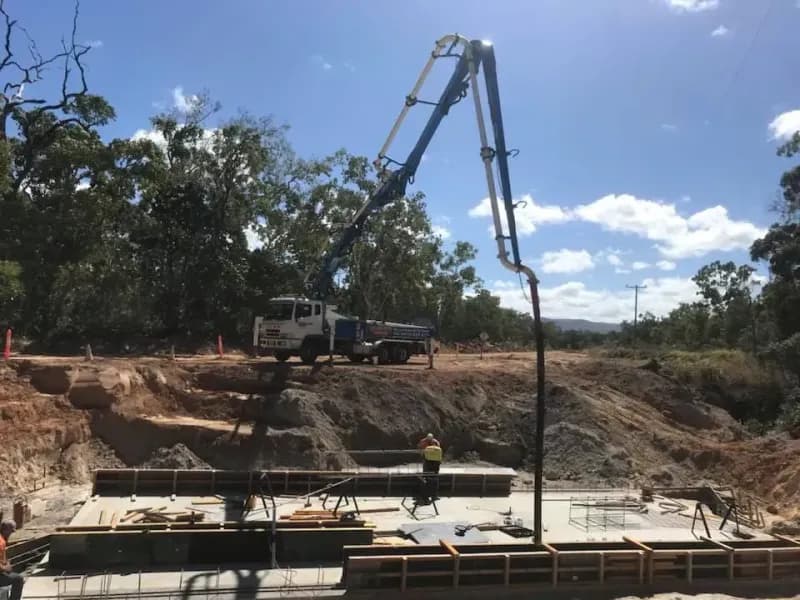

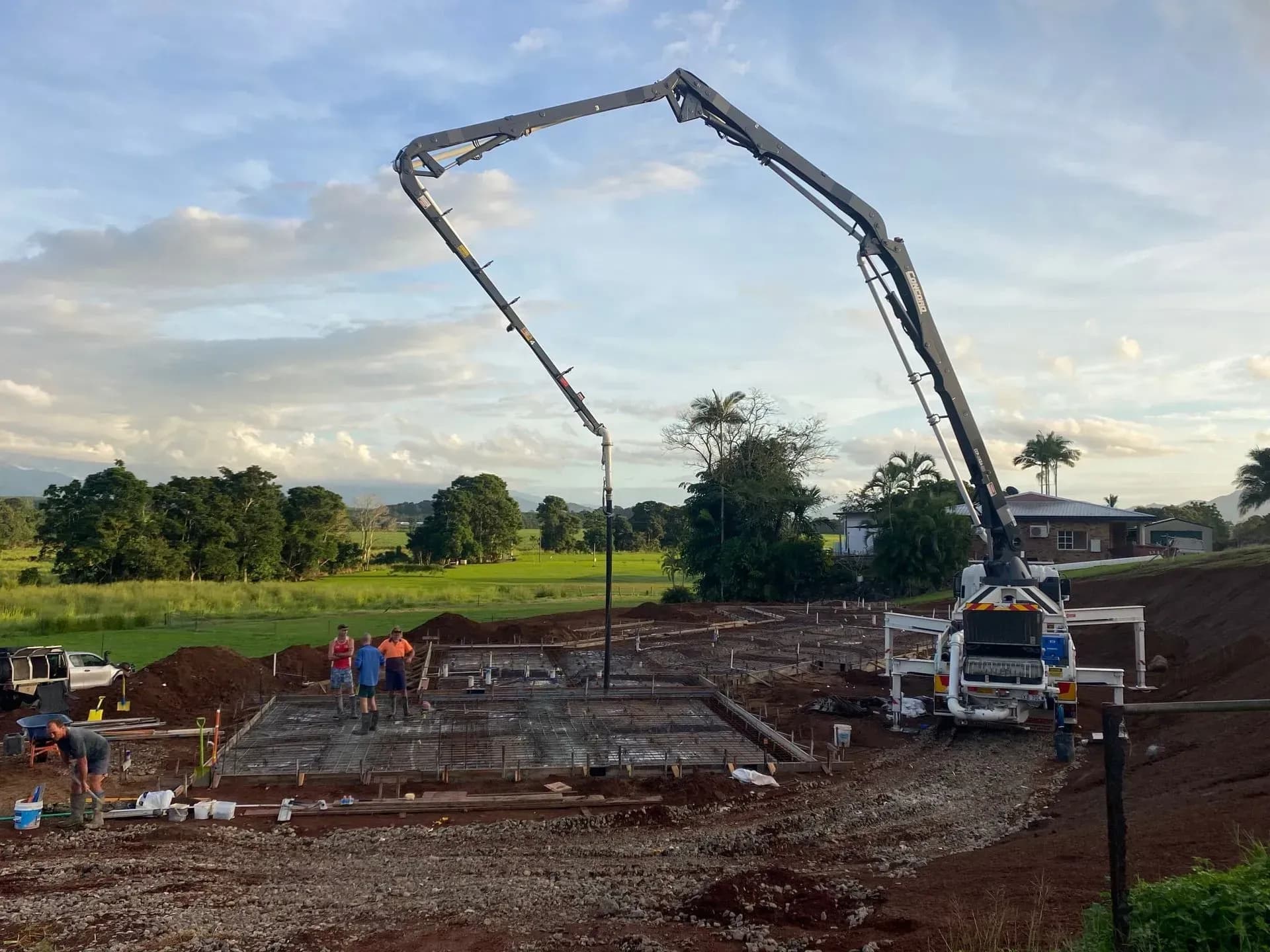
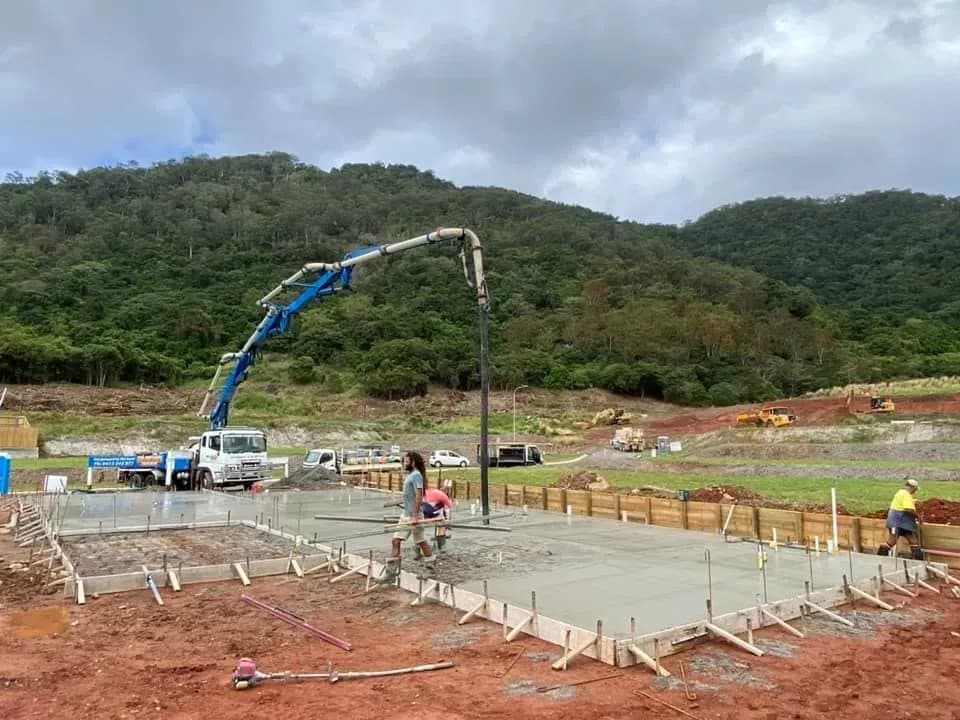
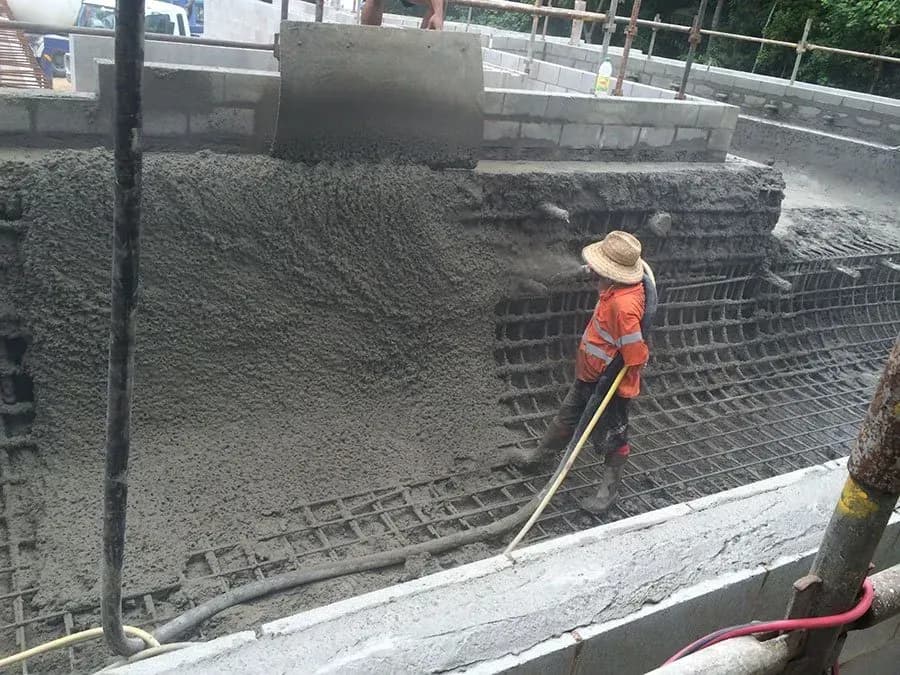


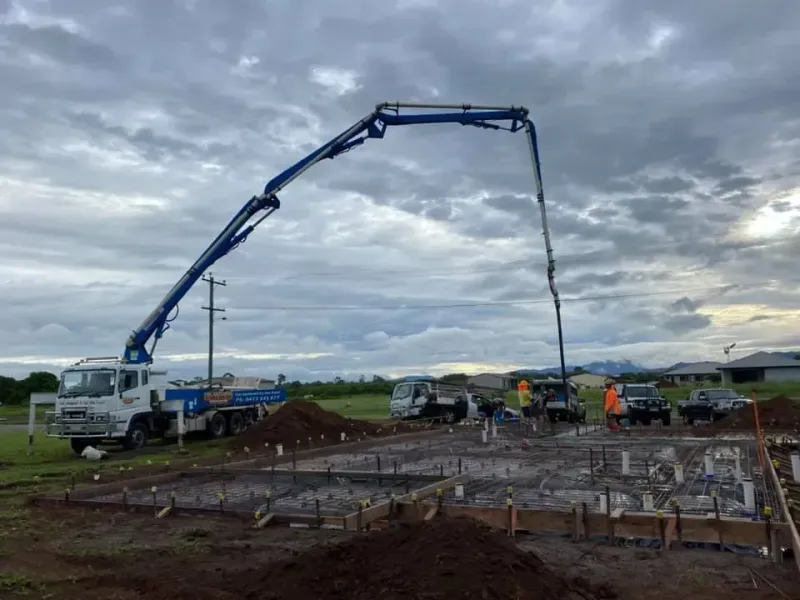
In brief
Plasticiser, not site water, and the premix supplier chooses it within the designer's specification. The common types are water reducers (plasticisers), superplasticisers, set retarders, set accelerators and air entrainers. On a pumped pour, a plasticiser adds workability without the strength cost of site water, and a retarder helps in heat or on a long haul. Agree both with the supplier when you order, not at the truck.
On this page
Concrete admixtures in one answer
A concrete admixture is an ingredient other than cement, water and aggregate, added in small quantities to change how long concrete takes to set and harden, or how workable it is.
Australian sources agree on the definition. Boral ties it to AS 1478.1 and to the plastic or hardened properties of concrete. Cement Concrete & Aggregates Australia (CCAA), the national industry body, names setting time and workability. Sika, an admixture maker, adds durability and early and final strength.
Admixtures are a normal part of premixed concrete, not an exotic extra. Most concrete is described by the supplier as a summer mix or a winter mix, with admixtures that adjust setting time to the season (CCAA Guide to Concrete for Housing).
The main types of admixture and what each does
Admixtures are grouped by their main effect on the concrete, and in Australia they are produced to AS 1478.1 (CCAA). Queensland's Department of Transport and Main Roads (TMR) uses the same families in its MRTS70 concrete specification: water reducing, set retarding, set accelerating and air entraining, used alone or in combination.
Common concrete admixtures and where they come up on a pumped pour
| Admixture type | What it does | Where it comes up on a pumped pour | Who decides |
|---|---|---|---|
| Water reducer (plasticiser) | Disperses the cement so the mix is more workable without extra water (CCAA) | The usual way to get a mix that flows down the line without hosing water into the truck | Supplier, within the specification |
| High range water reducer (superplasticiser) | Greatly increases slump and fluidity without extra water (Boral, CCAA) | Congested reinforcement or awkward formwork; on TMR long-haul work, one option adds it at site | Supplier and designer |
| Set retarder | Slows the setting of concrete (CCAA) | Warm to hot weather and long hauls from the plant | Supplier, often as part of a summer mix |
| Set accelerator | Shortens setting time (CCAA) | Cool to cold weather; see the climate figures below | Supplier, often as part of a winter mix |
| Air entrainer | Puts minute air bubbles in the mix to improve workability and cohesiveness and lower water demand (CCAA); also used for frost resistance (Boral) | Improves workability and cohesiveness; CCAA warns too much reduces strength | Designer and supplier |
| Waterproofing admixture | Reduces the permeability of concrete or mortar (CCAA) | Specified for the structure, not for pumping | Designer |
Water reducers are the most common type, and retarders and accelerators are used in summer and winter to counter the effect of hot or cold weather on setting times (Boral). A docket or data sheet may also use other names: Sika's Australian range lists mid range water reducers, viscosity modifying agents, corrosion inhibitors and evaporation retarders.
What is the difference between a plasticiser and a superplasticiser?
A plasticiser and a superplasticiser are both water-reducing admixtures that make concrete more workable without adding water. A superplasticiser is the high range version, used where the concrete must flow much more than a normal mix.
Plasticiser and superplasticiser compared, in the words of CCAA and Boral
| Admixture | CCAA describes it as | Boral describes it as | Where it is used |
|---|---|---|---|
| Plasticiser (water reducer) | Disperses the cement particles and improves workability without the addition of water | Helps produce a medium slump, workable concrete requiring less mixing water | The most common admixture type (Boral) |
| Superplasticiser (high range water reducer) | Increases the fluidity of the concrete for easier placement | Can greatly increase the slump without the need for additional water | Congested reinforcement, or formwork that makes placement difficult (CCAA) |
CCAA's Concrete Basics lists a plasticiser as one of three ways to make a mix more workable, alongside more cement paste and well graded aggregate. For superplasticisers, CCAA adds two cautions worth passing on to the crew: working time depends on the type and dosage, and a superplasticiser does not remove the need for proper compaction. A flowing mix still has to be vibrated.
Admixtures and pumping: a plasticiser beats the hose
For a pumped pour, the answer to 'plasticiser or water?' is a plasticiser agreed with the supplier, because water added to make a mix flow lowers the strength and durability of the concrete.
CCAA's advice is to never make a mix more workable by just adding more water. US guidance from the American Concrete Pumping Association (ACPA) says the same from the pump side: when possible, use admixtures instead of water to achieve higher slump. It lists water reducers as typically increasing workability and pumpability and decreasing segregation, which keeps concrete moving through a line in one piece.
Workability lost on the way matters too. US guidance from ACPA warns that slump loss through the pump can negatively affect pumping, and our guide to concrete pump blockages covers what happens when a stiff load meets the line.
On Queensland road and bridge contracts, TMR's MRTS70 requires any admixture added at the time of delivery to be accurately measured and the amount recorded. Our guide to pump mix concrete explains slump, tolerances and what to order so the load arrives ready to pump.
When does a pumped pour need a set retarder?
A set retarder slows the setting of concrete, and it is useful in warm to hot weather and when the mix must travel a long distance from the plant. Both conditions can apply to summer pours on the Tablelands and in Cape York.
How long the delay lasts depends on the dosage. US guidance from ACPA puts it at a few minutes to several hours, and notes that most retarding admixtures also act as water reducers.
Long hauls on TMR work have their own options. MRTS70 lists a set retarder at the batch plant plus a high range water reducer at site as one option for up to 120 minutes, and allows slump retention admixtures for long distance concrete. Our 90 minute rule guide covers how a retarder fits the delivery clock.
Do pours in Far North Queensland need a set accelerator?
A set accelerator shortens setting time and is often used in cool to cold weather, according to CCAA. Bureau of Meteorology averages for Far North Queensland are warmer than that.
Bureau of Meteorology long-term averages for two Far North Queensland stations
| Station | Month | Measure | Value |
|---|---|---|---|
| Cairns Aero | July | Mean minimum temperature | 17.2 degrees |
| Mareeba Airport | July | Mean minimum temperature | 14.2 degrees |
| Mareeba Airport | November | Mean maximum temperature | 31.9 degrees |
US guidance from ACPA notes that concrete sets quickly in hot weather. So on most FNQ pours the setting question is how to slow the concrete down, not speed it up, and our guide to pouring concrete in hot weather covers the rest of a hot-day plan.
Set, surface and evaporation retarders are three different products
Three different products are called a retarder, and only one of them is an admixture in the mix. A set-retarding admixture goes into the concrete at the batching plant and slows the whole load.
The other two go on the slab. A surface set-retarder slows the setting of the surface to a predetermined depth without affecting the set of the mass of the concrete (CCAA flatwork guide). An evaporation retarder, such as aliphatic alcohol, forms a chemical film that reduces the rate at which water evaporates (CCAA hot weather data sheet). It reduces early age plastic cracking in rapid drying conditions but is not a curing compound, because its effect is temporary (CCAA Concrete Basics).
The three kinds of retarder used on concrete
| Product | Where it goes | What it does | Who handles it |
|---|---|---|---|
| Set-retarding admixture | In the mix, at the batching plant | Slows the setting of the whole load | Premix supplier |
| Surface set-retarder | On the surface after placing | Slows the surface to a set depth so the paste can be washed off to show the stone | Concreter |
| Evaporation retarder | Sprayed on during finishing | Forms a film that slows surface evaporation; temporary, not a curing compound | Concreter |
Say which one you mean when you ring the plant or the concreter. Our guide to exposed aggregate concrete covers where the surface retarder fits in that finish.
Waterproofing admixtures: lower permeability, not a membrane
A waterproofing admixture reduces how easily water passes through concrete; the sources here do not describe it as making concrete fully waterproof. Well made concrete is already dense and reasonably watertight (CCAA Concrete Basics), and the admixture lowers the permeability of concrete or mortar further (CCAA Guide to Concrete for Housing).
Three cautions apply. Some of these products may themselves cause efflorescence, deposits of soluble salts on the surface, so check with the manufacturer (CCAA). A waterproof layer is a separate job: CCAA describes toppings used in waterproofing applications by allowing a polythene sheet or other waterproof membrane to be installed. And curing matters, because good curing reduces the volume of pores, which reduces permeability and improves watertightness (Boral).
Which admixtures are restricted or ruled out?
On Queensland road and bridge contracts, TMR's MRTS70 specification rules out admixtures containing calcium chloride, and rules out sugar as a set retarder unless it is part of an AS 1478.1 complying admixture.
MRTS70 also requires admixtures to conform to AS 1478, be used in accordance with AS 1379, and be a registered product from a registered supplier. The specification applies to TMR contracts only, but it shows the controls a registered admixture sits under.
The concern with calcium chloride is reinforcement corrosion. US guidance from ACPA says it can contribute to corrosion of reinforcing steel and is prohibited or very limited in most structural concrete. In Australia, CCAA's flatwork guide also names calcium chloride admixtures among the major contributors to large dark blotches on flatwork.
Who decides which admixtures go in the mix
The supplier chooses the admixtures, within limits set by whoever designed the job. CCAA's Concrete Basics says the choice of admixtures is normally left to the premix supplier.
The designer's limits come first. The class of concrete and all other requirements should be set out on the plans or specification and not varied without the designer's approval, and admixtures and additives are among the requirements a special-class order can set (CCAA Ordering Premixed Concrete). In practice the work splits three ways:
- The designer or engineer sets the concrete the job needs.
- The supplier designs a mix, admixtures included, to meet it.
- The builder or concreter tells the supplier about the placing method, the weather and the travel time, so the mix suits the day.
What we ask about the mix when you book the pump
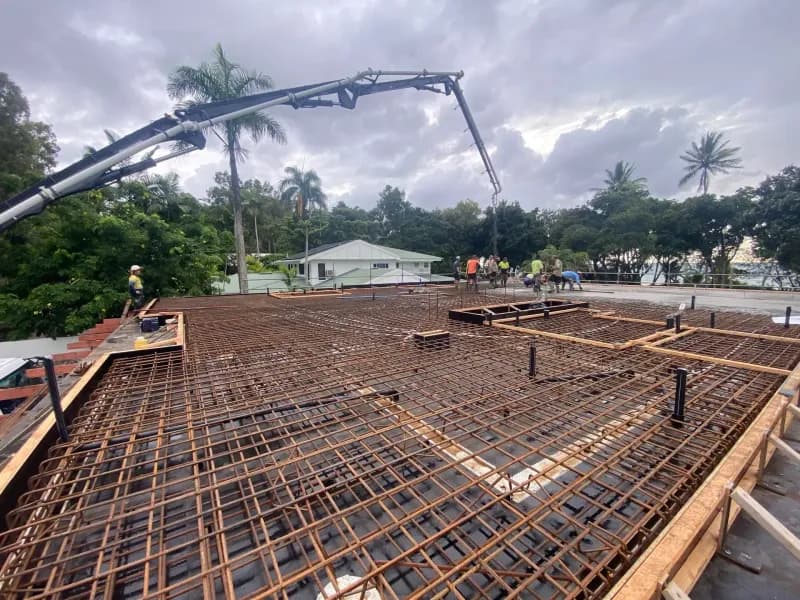
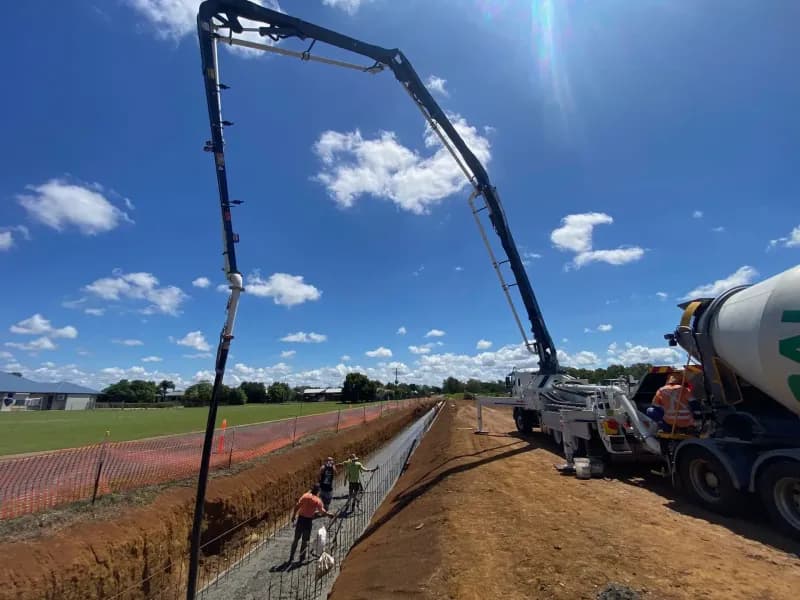
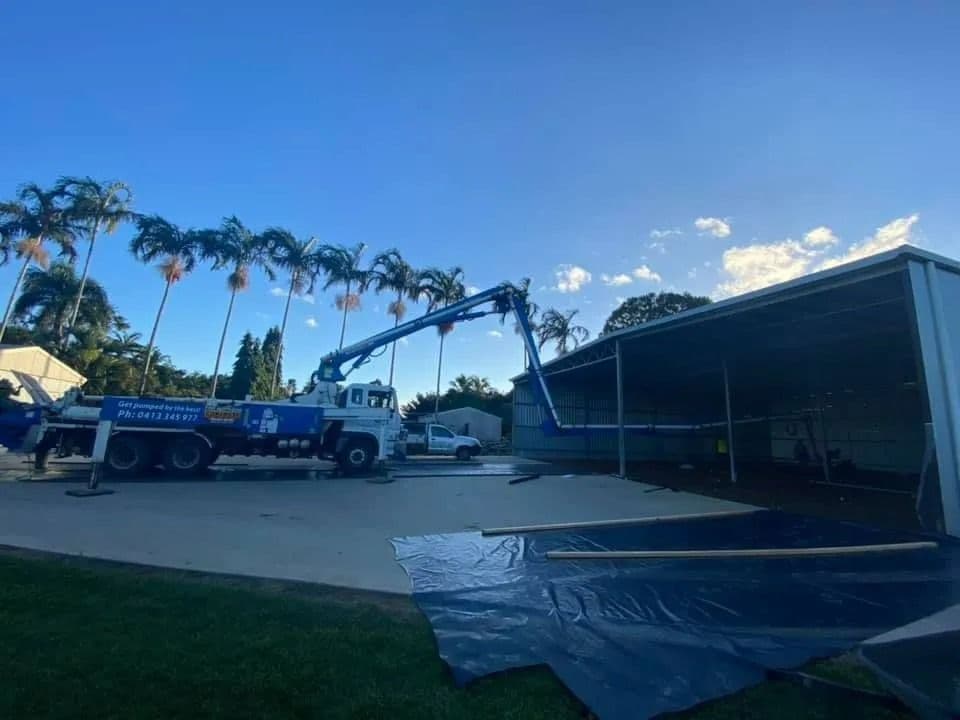
When you book, we ask for the location, the type of pour and the volume your supplier has quoted, and it helps to add the mix the plant is sending. The mix plays a part in which pump suits the job, because certain pumps may perform better with specific consistencies or aggregates.
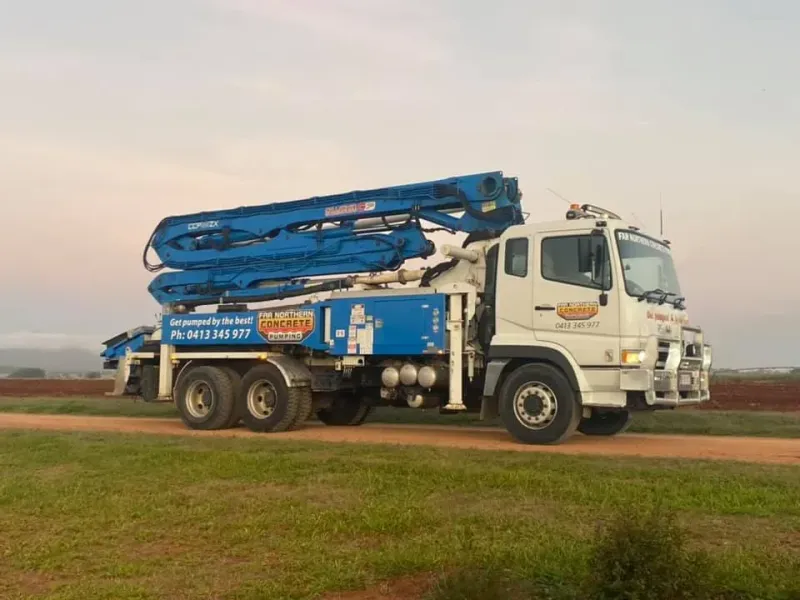
We are based in Mareeba, have operated since 2014, and our operators have access to a 31m boom pump, 28m boom pump, 20m boom pump and line pump. The booking questions, and why each one matters to the mix:
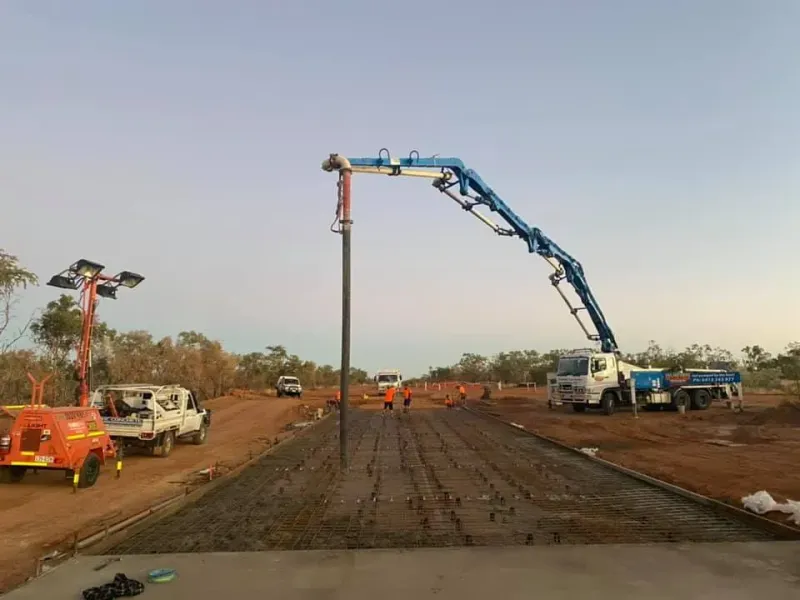
- The location of the pour. We also work rural and remote worksites and mine sites across the Tablelands region and Far North Queensland, where travel time and heat make a retarder conversation with your supplier worth having.
- The type of pour, such as a residential driveway or slab or a commercial floor.
- The volume your supplier has quoted.
- The mix the plant is sending, including the slump you ordered and whether a retarder or summer mix is in it, so we can match the pump and line to it.
What to agree with your supplier before a pumped pour
Have the admixture conversation when you order, not when the first truck arrives. CCAA's Ordering Premixed Concrete data sheet says that for placing by pump, the type of pump and the size and length of line should be specified, because these affect the mix design. Use this as a checklist on the phone to the plant:
- Tell the plant a pump is booked, which type, and the line size and length.
- Ask for the workability you need as a slump figure, and ask how the plant will reach it rather than planning to add water on site.
- Give the pour start time and the distance from the plant, and ask whether a retarder or summer mix is in the recipe for a hot day or a long haul.
- If the finish is exposed aggregate, say so, and confirm who supplies any surface set-retarder.
- Check the plans or specification for anything the designer has fixed about admixtures, and pass it on unchanged.
- Agree that any adjustment to a load on site is made by the supplier, with any admixture added at the truck dosed and recorded.
Next steps
When your supplier has quoted the volume, contact us or ring 0413 345 977 with the location, the type of pour, the volume and the mix to book the pump. Our guide to pump mix concrete covers slump, tolerances and the full ordering checklist, and cement vs concrete explains the base ingredients the admixtures are working on.
Sources
- Guide to Concrete for Housing, Cement Concrete & Aggregates Australia. Accessed 30 October 2026.
- Concrete Basics: A Guide to Concrete Practice (seventh edition, February 2010), Cement Concrete & Aggregates Australia. Accessed 30 October 2026.
- Ordering Premixed Concrete (data sheet, September 2017), Cement Concrete & Aggregates Australia. Accessed 30 October 2026.
- Hot Weather Concreting (data sheet), Cement Concrete & Aggregates Australia. Accessed 30 October 2026.
- Guide to Concrete Flatwork Finishes, Cement Concrete & Aggregates Australia. Accessed 30 October 2026.
- Australian Concrete Guide (2023), Boral. Accessed 30 October 2026.
- Admixture Technology, Sika Australia. Accessed 30 October 2026.
- Technical Specification MRTS70 Concrete (July 2022), Queensland Department of Transport and Main Roads. Accessed 30 October 2026.
- Climate statistics for Australian locations: Cairns Aero, Bureau of Meteorology. Accessed 30 October 2026.
- Climate statistics for Australian locations: Mareeba Airport, Bureau of Meteorology. Accessed 30 October 2026.
- Concrete 101: A guide to understanding the qualities of concrete and how they affect pumping, American Concrete Pumping Association. Accessed 30 October 2026.