



In brief
To work out how much concrete you need for a driveway, multiply its length by its width by its depth, all in metres, to get cubic metres. Then add an allowance for wastage (Australian premix supplier Hunter Readymixed Concrete suggests about 10% for small jobs) and round up to the next 0.1 m3 before you ring your concrete supplier.
On this page
The formula: length x width x depth in metres
The volume of concrete for a driveway, slab or path is length x width x depth, with every measurement in metres, and the answer is in cubic metres (m3). Cockburn Cement's estimating guide gives the same rule: multiply length by width by thickness. The step people trip on is depth, because plans show it in millimetres. Divide millimetres by 1,000 first, so 50 mm becomes 0.05 m and 100 mm becomes 0.1 m. Cockburn's own example is 10 m x 15 m x 50 mm, which is 10 x 15 x 0.05 = 7.5 m3.
Measure the area on site rather than reading it off the plans. Premix supplier Holcim says estimates should be based on site measurements rather than drawings. The ground and the formwork you actually built are what the concrete has to fill. For an L-shaped driveway or a slab with a step in it, split the area into rectangles, work out each one, then add them together.
Concrete calculator
This concrete calculator turns your length, width and depth into cubic metres, then adds the allowance you choose. Enter the length and width in metres and the depth in millimetres exactly as it appears on your plans. Pick an allowance, check the result, and confirm the final figure with your concrete supplier before you book.
Concrete volume calculator
Enter length, width and depth to see the volume.
Worked examples: driveway, shed slab, path
These worked examples show the whole sum from measurements to the order, using a 10% allowance and rounding up to the next 0.1 m3. The depths are examples only, chosen to show the arithmetic. Use the depth on your own plans. Hunter Readymixed Concrete's published example follows the same steps: a garage slab measured at 2.85 m3, plus 10% (0.28 m3), gives 3.13 m3, rounded up to an order of 3.2 m3.
Concrete volume worked examples (example depths, 10% allowance, rounded up to 0.1 m3)
| Job | Measurements | Measured volume | Plus 10% | Order |
|---|---|---|---|---|
| Single driveway | 12 m x 3.5 m x 100 mm | 4.2 m3 | 4.62 m3 | 4.7 m3 |
| Shed slab | 6 m x 4 m x 100 mm | 2.4 m3 | 2.64 m3 | 2.7 m3 |
| Garden path | 15 m x 1.2 m x 75 mm | 1.35 m3 | 1.49 m3 | 1.5 m3 |
| Garage slab (Hunter example) | Estimated from measurement | 2.85 m3 | 3.13 m3 | 3.2 m3 |
Small jobs still add up to a lot of material. One cubic metre of concrete is 1,000 litres and weighs about 2,400 kg, and Hunter notes that a standard 50 litre wheelbarrow takes 20 trips to move it. The 1.5 m3 path above is around 30 full barrow loads. Mixing it from bags is also a big job: Cement Australia says its Concrete Mix needs about 110 x 20 kg bags per cubic metre, so the same path is roughly 165 bags. Other brands differ, so check the yield printed on the bag you buy.
Why you order a little extra
You order a little more concrete than the measured volume because real sites never match a perfect rectangle. Holcim lists the factors to allow for: variations in slab thickness, distorted formwork, over-excavation, uncompacted sand, and uneven subgrade levels. A low spot in the base, or a trench dug deeper than planned, takes concrete that a tape measure across the top never shows.
As a general rule for small projects, Hunter Readymixed Concrete suggests allowing 10% extra for wastage. Hunter says that margin allows for small errors in estimating and for concrete left in the hopper of a concrete pump. Hunter also makes the cost point plainly: it is far more economical to order a little extra than to order a small additional quantity to finish the job. Holcim also notes that plus or balance loads are subject to truck availability and may incur additional fees.
- Measure the formwork you built, not the plan.
- Check the base for low spots and soft sand before the pour.
- Add the allowance after measuring, then round up.
- Ask your supplier if their rounding or allowance advice differs.
Extra concrete when you use a pump
When concrete is placed by a pump, some of the order stays in the pump rather than in your slab, so the allowance needs to cover it. Hunter Readymixed Concrete's ordering guidance says the usual wastage allowance is there partly to cover concrete left in the hopper of a concrete pump. It is worth asking your pump operator how much to allow before you lock in the order.
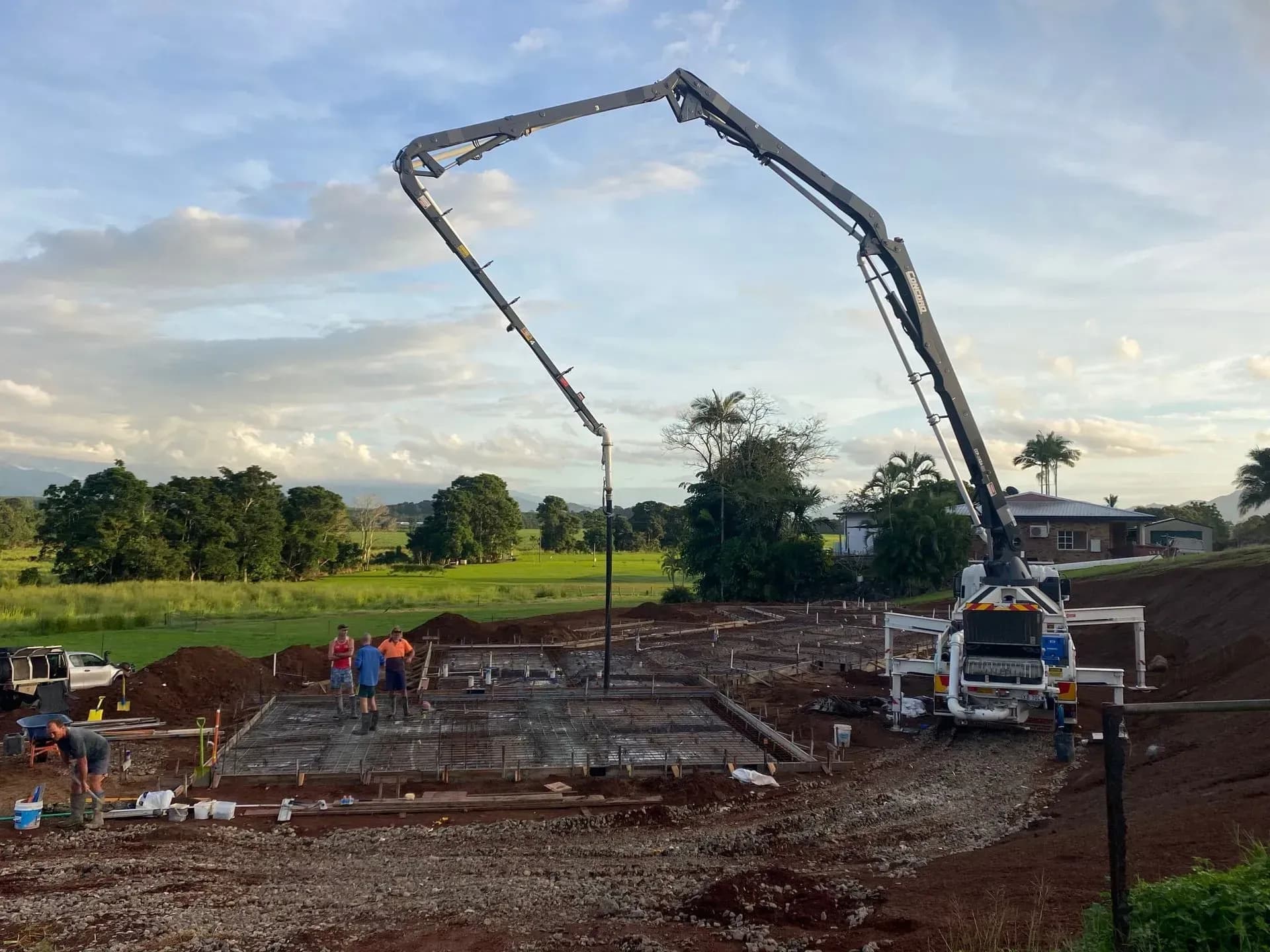
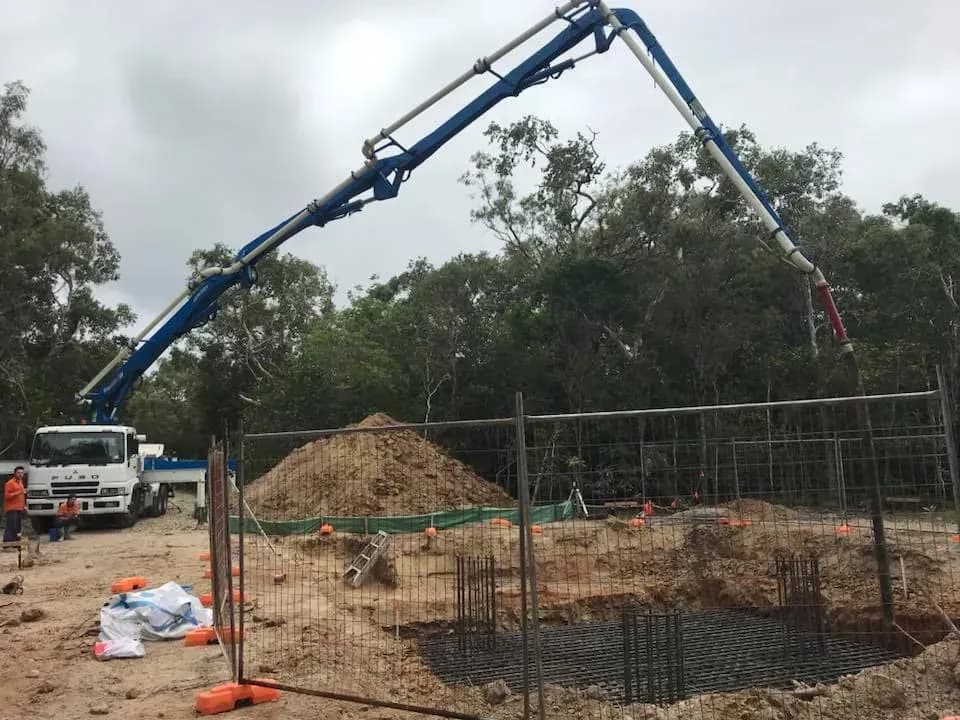
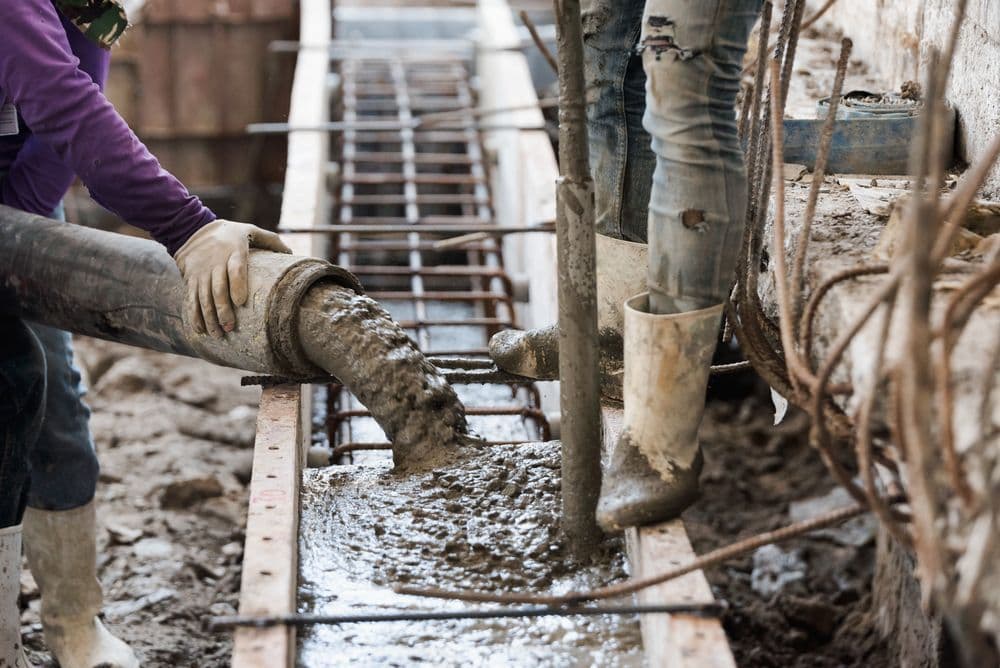
The pump also changes what you tell the concrete supplier. Holcim and the Cement Concrete & Aggregates Australia ordering guidance both say the supplier needs to know the placement method, the type of pump, and the size and length of the line, because these affect the mix design. A line pump feeds concrete through hoses run along the ground, so a long run from the street to a backyard slab is exactly the detail to pass on. Our guide to pump mix concrete explains why the mix matters, and line pump vs boom pump covers which setup suits your access.
Ordering: rounding up and minimum loads
When you order premix, round your total up and check the supplier's minimum load terms before you settle on a number. Hunter says concrete can be ordered in multiples of 0.1 m3, so a calculated 4.62 m3 becomes 4.7 m3. Your local plant may round differently, so ask. Small loads can carry an extra charge: Holcim's North Queensland service fee schedule, effective 1 May 2026, applies a fee to delivered loads under 4 m3. That is one supplier's schedule, so treat it as a reason to ask your local plant about its own terms rather than as a price.
Give the supplier the same information every time: the volume in cubic metres, the mix, the delivery address, a site contact, how fast you want it delivered, and whether it is placed by pump or off the chute. If you are booking a pump too, tell them which pump and the line length. Our guide to preparing your site for a concrete pump covers access for the trucks on the day.
What to have ready before you ring the concrete supplier
| Item | Why the supplier asks |
|---|---|
| Volume in m3, with allowance, rounded up | Tells the plant how much to batch and deliver |
| Placement method: pump or chute | Affects the mix design |
| Pump type and line length | Affects the mix design |
| Delivery rate | Lets the plant schedule trucks to match |
| Delivery address and site contact | Gets the truck to the right place |
Next steps
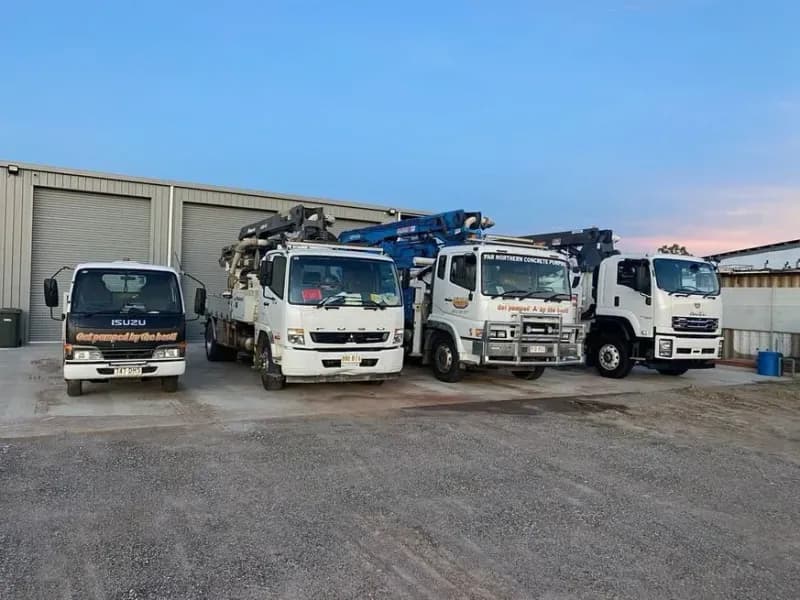
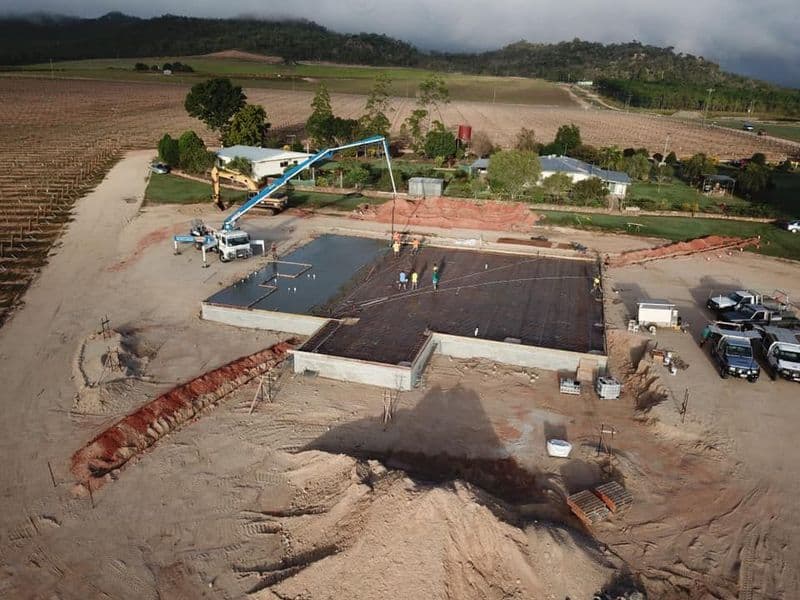
Once you have a volume, the next question is usually what the pump will cost. Our concrete pump hire cost guide walks through what drives the price. Far Northern Concrete Pumping is based in Mareeba and we pump for residential driveways, house slabs and pathways across the Tablelands and Cairns. See our concrete pumping services, then contact us or call 0413 345 977 with your location, the type of pour and the volume your supplier has quoted. We'll pencil in your date and confirm once your concrete order is locked in.
Sources
- Concrete Estimating Guide (Easy Estimator), Cockburn Cement. Accessed 4 October 2026.
- 5 Essential Things You Need to Know When Ordering Premixed Concrete, Holcim Australia. Accessed 4 October 2026.
- North Queensland Service Fees (effective 1 May 2026), Holcim Australia. Accessed 4 October 2026.
- Ordering Premixed Concrete, Hunter Readymixed Concrete. Accessed 4 October 2026.
- Ordering Premixed Concrete (data sheet), Cement Concrete & Aggregates Australia. Accessed 4 October 2026.
- FAQs, Cement Australia. Accessed 4 October 2026.
- Concrete for post holes calculator, Cement Australia. Accessed 4 October 2026.