



In brief
The finish comes from removing the cement paste while the surface is firm but not dry. In Queensland the washed-off paste is a listed water contaminant, so it must not reach the gutter. Tell the supplier a pump is coming so the mix and the line match.
On this page
Exposed aggregate concrete in one answer
Exposed aggregate concrete is ordinary concrete whose top layer of cement paste is removed so the stones inside it show at the surface. Cement Concrete & Aggregates Australia (CCAA), the national industry body, calls it an attractive decorative finish in its Concrete Basics guide, and notes that different sizes and colours of aggregate allow many different appearances. Boral, one of the premix suppliers that sells it, describes its Exposé range the same way: removing the surface fines exposes the embedded aggregate and leaves a textured finish for driveways, patios, paths and pool surrounds. Holcim's Geostone range lists driveways, outdoor entertainment areas and pool surrounds among its most popular uses.
Aggregate is simply the sand and stone in any concrete. Heidelberg Materials describes its exposed product as made by exposing some of the aggregates, the sand and small stones, in the concrete. This guide uses aggregate concrete to mean this finish: concrete where you choose the stone because you are going to see it. The rest of the slab is still ordinary concrete. CCAA notes that the class of concrete and its other requirements are set out on the plans or specification and should not be varied without the designer's approval, and choosing a decorative finish does not change that.
How the finish is made: three methods
CCAA's Concrete Basics sets out three ways to get an exposed aggregate finish. The first uses the concrete exactly as delivered; the other two add special aggregate to the surface straight after placing. In all three, timing is the skill, because the cement paste has to come off while the surface is firm but not dry.
- Wash off the paste: make the concrete as normal, wait until the surface is firm but not dry, then brush, wash or broom away the cement paste until the aggregate shows, and cure the concrete. CCAA says a surface retardant can be used to aid the process.
- Seed the surface: place, compact and level the concrete to about 10 mm below the top of the forms, spread selected aggregate over it in a layer and press it in until it is completely covered.
- Topping coat: place the concrete to about 5 mm below the forms, then spread a topping of aggregate and cement paste in a 2:1 ratio, level it, tamp it down and finish it with a trowel.
For both added-aggregate methods, CCAA says to leave the concrete until the surface paste is firm but not dry, then brush it, or wash some of it away with a fine mist spray. Boral describes the same order for its mixes: once the concrete is placed and partially cured, the top layer is removed by washing, brushing or a surface retarder, and the surface is then sealed. Boral recommends professional installation to get the correct exposure level, and says decorative concrete needs careful handling and curing, especially on driveways.
Exposed aggregate vs plain concrete: more texture, higher upfront cost
Exposed aggregate typically costs more up front than plain concrete, because of the decorative finish and the extra processing. Boral's pricing guide says exposed aggregate typically comes at a higher upfront cost than conventional concrete because of the decorative finish and the additional processing. It names what moves the price: the size, colour and source of the aggregate; added colour, which raises the cost slightly; intricate designs, curves or borders; and site work such as uneven ground, poor drainage or excavation. Boral supplies the concrete but does not install it, so the finishing labour is a separate quote from your concreter. We found no primary source for a reliable price per square metre in Far North Queensland, so this guide gives none. The table compares the two finishes on the points the sources cover.
Plain concrete and exposed aggregate compared
| Factor | Plain concrete | Exposed aggregate |
|---|---|---|
| What shows at the surface | Cement paste, finished smooth or textured | The stones in the mix, with the paste removed |
| Grip | CCAA: a well trowelled surface can be slippery when wet; a broomed surface is skid-resistant | Boral and Heidelberg Materials describe it as slip-resistant (manufacturer statements) |
| Aggregate | 20 mm supplied unless you specify 10 or 14 mm (CCAA) | Chosen for size and colour from the supplier's decorative range |
| Upfront cost | The baseline | Typically higher, for the finish and extra processing (Boral) |
| Upkeep | Depends on the finish and any coating | Sealed after installation, resealed every few years (Boral) |
Colour can be added to either finish. If you add it, CCAA recommends a minimum grade of 25 MPa for coloured concrete used in domestic paving, and colour is one of the properties that can make a premix order special class rather than normal class. CCAA adds that other forms of decorative concrete, and commercial work, will normally need a higher grade, so use the grade set out on your plans or specification.
Choosing the stone and the cement colour
Plain concrete is grey because standard cement is grey, and on an exposed finish that paste colour sits around every stone. CCAA notes that a white or off-white cement may suit a light stone where a grey cement may clash, and that aggregates to be exposed can be selected for their colour. Boral sources its stone from local quarries, so its exposed aggregate colour range varies by region, and Heidelberg Materials lists Cairns, Innisfail, Port Douglas and Tully among the regions in the selector on its Imagecrete Exposed page, so the choices available in Far North Queensland may differ from a southern brochure. Natural stone also varies. Boral and Holcim Geostone both warn of variation from batch to batch, and Boral recommends making the final colour choice from an actual sample. CCAA's advice is to do a test area first to see what the finish will look like before the whole driveway goes down.
Can exposed aggregate be pumped? Yes, if the stone and mix suit the line
An exposed aggregate mix can go through a concrete pump provided its largest stone suits the diameter of the pump line and the rest of the mix is designed for pumping. Queensland's concrete pumping code of practice, published by WorkSafe Queensland, says there is a maximum aggregate size for each pipeline diameter, and that the line diameter should be three to four times greater than the maximum aggregate size. The same code lists aggregate that is too large among the mix design causes of line blockages, and notes that a kinked discharge hose can block depending on the mix design and aggregate size. The American Concrete Pumping Association, a United States body, cites the US guide ACI 304 in suggesting the largest angular stone be limited to one third of the smallest inside diameter of the delivery system, which lands in the same place. The table applies the Queensland ratio to the aggregate sizes CCAA says can be ordered.
Line diameter implied by the WorkSafe Queensland ratio (simple arithmetic: aggregate size x 3 and x 4)
| Maximum aggregate size | Line diameter at 3 times | Line diameter at 4 times | Ordering note (CCAA) |
|---|---|---|---|
| 10 mm | 30 mm | 40 mm | May be specified instead of 20 mm |
| 14 mm | 42 mm | 56 mm | May be specified instead of 20 mm |
| 20 mm | 60 mm | 80 mm | Supplied when no size is specified |
Ordering a pumpable exposed mix: tell the plant about the pump
The batching plant can only design a decorative mix to suit the pump if it knows a pump is coming. CCAA's Ordering Premixed Concrete data sheet says the supplier needs to know how the concrete will be placed, such as chute or pump, because the method will influence the concrete mix design, and that for a pump the type of pump and the size and length of line should be specified. Aggregate size can itself be set by the placement method, the thickness of the section and the spacing of the reinforcement. Our own equipment notes make the same point from the pump side: certain pumps may perform better with specific consistencies or aggregates. So settle the pump first, then ask the plant whether the decorative mix you chose suits that line before the order is locked in. Our pump mix guide covers the rest of that phone call, including slump, and what happens when a mix and a line do not match.
Washing off: in Queensland the slurry must stay out of the gutter
The cement paste washed off an exposed aggregate surface is named in Queensland law as a water contaminant, so it has to be caught on site rather than hosed into the street. Schedule 10 of the Environmental Protection Regulation 2019 lists building and construction materials, including cement and concrete, as prescribed water contaminants, and the example it gives is cement washed to create exposed aggregate treatment. The same schedule also lists a liquid containing suspended or dissolved solids. Section 440ZG of the Environmental Protection Act 1994 says a person must not unlawfully deposit a prescribed water contaminant in waters, a roadside gutter or stormwater drainage, or at another place where it could reasonably be expected to wash, blow, fall or move into them. The Act's own example is a building site where soil may be washed into an adjacent roadside gutter. The maximum penalty is 600 penalty units, or 1,665 penalty units if the deposit is wilful, under the Act as current at 29 June 2026.
The practical step is to agree before pour day who will catch the wash-off water on your job, where it will be held, and how it will be removed, so nobody is improvising with a hose next to the kerb. Our guide to concrete washout covers catching and disposing of concrete wash water in more detail.
Grip, sealing and cleaning: what living with it involves
Exposed aggregate is sold as the grippy option, and it needs regular sealing to protect it from staining and wear. CCAA notes that a well trowelled concrete surface will be very smooth and can be slippery when wet, while drawing a broom across fresh concrete gives a skid-resistant surface. Boral says the textured exposed surface provides slip resistance for high-traffic and wet areas and suits sloped driveways, and Heidelberg Materials also calls its exposed finish slip-resistant. These are manufacturer descriptions rather than published test ratings, so if grip matters on a steep driveway or around a pool, ask your concreter what the finished surface has been tested to.
Boral says an exposed aggregate driveway should be sealed once installed to protect it against staining and weathering, that sealing every few years protects it from moisture, stains and wear, and that resealing should be in your budget, depending on use and exposure. For cleaning, Boral suggests water and a mild detergent, and warns that harsh chemicals and high-pressure washing can damage the surface.
- Cracking: Boral lists excess water in the mix, rapid moisture loss during curing and poor joint placement as causes, and recommends evaporation retarders and keeping the concrete moist for at least seven days.
- Efflorescence: a white, powdery residue caused by water-soluble salts moving through the concrete. Boral says applying a sealer after cleaning reduces the chance of it coming back.
- Upkeep: Boral's guidance means a reseal every few years, an ongoing cost to plan for from the start.
What to ask your concreter and your supplier
Use this checklist when you get quotes.
- Which method will you use: washing off the paste, seeding the surface or a topping coat?
- Which aggregate size and colour, and can I see a sample or a test area first?
- Will the paste be grey, white or off-white cement, and does that suit the stone?
- Is the concrete being pumped, and does the largest stone in the mix suit the pump line?
- Who catches the wash-off water, and how will it be kept out of the gutter and stormwater drains?
- How will the slab be cured, and where will the joints go?
- Which sealer, when will it go on, and how often will it need resealing?
How we fit into an exposed aggregate pour
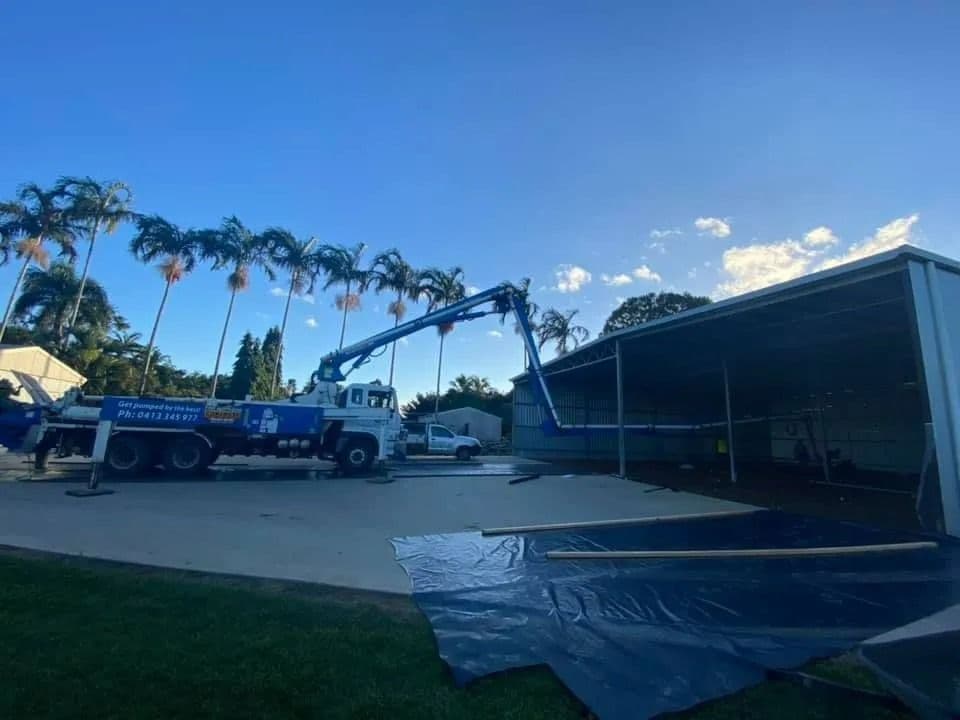
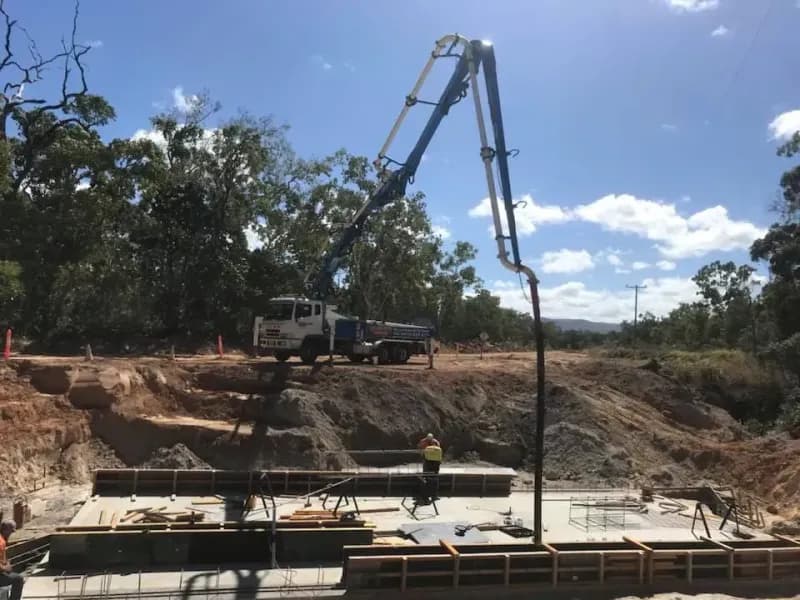
Far Northern Concrete Pumping is a concrete pumping business: you choose the mix with your concreter and premix supplier, and we pump it from the truck to the formwork. Our operators have access to a 31m boom pump, 28m boom pump, 20m boom pump and line pump, and we match the machine to the job rather than sending whatever happens to be free. The mix plays a part in that choice, because certain pumps may perform better with specific consistencies or aggregates, so tell us at booking that the pour is an exposed aggregate mix and which aggregate size the plant is supplying. We pump concrete for residential driveways, pathways and swimming pool surrounds, and have operated since 2014. From Mareeba we cover the Tablelands, Cairns and its suburbs, the coast north to Port Douglas and Cooktown, and south through Innisfail and Tully.
Next steps
Once you have settled on the finish, work out how much concrete to order with our guide to how much concrete you need, which converts driveway and path dimensions to cubic metres. If you are unsure which pump suits the site, line pump vs boom pump compares the two. See how our concrete pumping service works, then contact us or ring 0413 345 977 with the location, the type of pour and the volume your concrete supplier has quoted.
Sources
- Concrete Basics: A Guide to Concrete Practice (seventh edition, February 2010), Cement Concrete & Aggregates Australia. Accessed 30 October 2026.
- Ordering Premixed Concrete (data sheet, September 2017), Cement Concrete & Aggregates Australia. Accessed 30 October 2026.
- Exposed Aggregate Concrete Driveways & Landscaping, Boral. Accessed 30 October 2026.
- Exposed Aggregate Concrete FAQs, Boral. Accessed 30 October 2026.
- Exposed Aggregate Concrete Pricing Guide, Boral. Accessed 30 October 2026.
- Exposed Aggregate Driveway Solutions, Boral. Accessed 30 October 2026.
- Imagecrete Exposed Concrete, Heidelberg Materials Australia. Accessed 30 October 2026.
- Exposed Aggregate Concrete, Holcim Geostone. Accessed 30 October 2026.
- Concrete pumping code of practice 2019, WorkSafe Queensland. Accessed 4 October 2026.
- Environmental Protection Act 1994 (current as at 29 June 2026), section 440ZG, Queensland Government, Office of the Queensland Parliamentary Counsel. Accessed 30 October 2026.
- Environmental Protection Regulation 2019 (current as at 21 June 2026), schedule 10, Queensland Government, Office of the Queensland Parliamentary Counsel. Accessed 30 October 2026.
- Concrete 101: A guide to understanding the qualities of concrete and how they affect pumping, American Concrete Pumping Association. Accessed 30 October 2026.