





In brief
Yes, with precautions. Heat speeds up setting and surface drying, so book an early start, have the site ready for the first truck, shade and dampen what you can, and start curing as soon as the slab is finished. CCAA recommends precautions once air temperature rises above 30 degrees, a mark the average maximums at Cairns and Mareeba pass from November to February.
On this page
The short answer: yes, with precautions, and sometimes the answer is to wait
You can pour concrete in hot weather, but heat shortens every stage of the job, so the pour needs planning and sometimes a later start or a different day. Cement Concrete & Aggregates Australia (CCAA) treats hot weather as any combination of high air temperature, low humidity and high wind, and its hot weather data sheet says those combinations can cause placing and finishing problems at any time of year, not only in summer. The data sheet explains that as concrete temperature rises, the setting time, and with it the time to place, compact and finish the concrete, is reduced.
CCAA also says the first option to consider in hot, adverse weather is whether to postpone, because it is often better to wait than to risk costly repairs. In Far North Queensland the practical answer is usually an early start, a site that is ready for the first truck and a plan for curing before the afternoon heat arrives.
What temperature is too hot for concrete?
Two temperatures matter on a hot day: the concrete itself and the air around it. CCAA's hot weather data sheet, written against the 2007 edition of AS 1379, the Australian Standard for the specification and supply of concrete, gives a range of 5 to 35 degrees for concrete at the point of delivery. It recommends taking precautions once air temperature rises above 30 degrees, particularly if there is also a hot dry wind. Keeping the delivered concrete inside its range is the supplier's job, and CCAA suggests specifying a maximum acceptable delivery temperature so the supplier can plan to cool the materials. AS 1379:2026 replaced the 2007 edition in May 2026, so confirm the current limit with your supplier. None of the Australian sources cited here sets a single ideal pouring temperature; the consistent advice is to pour in the coolest part of the day.
Hot weather thresholds for concrete in Australia
| Threshold | What it means | Source |
|---|---|---|
| Concrete between 5 and 35 degrees at delivery | The delivered range CCAA gives from the 2007 edition of AS 1379; AS 1379 was revised in 2026, so confirm the current limit with your supplier | CCAA Hot Weather Concreting data sheet |
| Air above 30 degrees | Precautions usually recommended, especially with a hot dry wind | CCAA Hot Weather Concreting data sheet |
| Evaporation above 1 kg of water per square metre per hour | Take precautions against premature drying and plastic shrinkage cracking | CCAA Hot Weather Concreting data sheet |
| Air over 35 degrees | Postpone the job until it is cooler | Cement Australia FAQs |
What heat does to fresh concrete
Heat speeds up cement hydration and the evaporation of water from fresh concrete, and CCAA's data sheet traces most hot weather problems to those two effects. Here is how they show up on a slab:
- Faster setting: less time to place, compact and finish before the concrete firms up.
- Slump loss: higher temperatures increase the rate of slump loss, so the concrete stiffens sooner. Adding water to restore it raises the water/cement ratio, costing strength and durability.
- Poor compaction and cold joints: where water is not added, CCAA says the faster setting raises the risk of inadequate compaction, cold joints and poor finishes.
- Plastic shrinkage cracking: if water evaporates from the surface faster than bleed water rises, the surface dries and shrinks. CCAA's Concrete Basics says these cracks form on very hot days, or in low humidity and even moderate winds.
- Thermal cracking: a hot day followed by a cool night can open up a large temperature difference between the warm interior of a slab and its cooler surface.
- Long-term strength: higher concrete temperatures can lift the early rate of strength gain, but CCAA says this will often lead to reduced long-term strength.
The FNQ build-up: hot days, drier afternoons and wind
Bureau of Meteorology averages show that a typical summer afternoon in Far North Queensland is already at or past CCAA's 30 degree mark. Mareeba Airport averages 31.9 degrees in November and 32.1 degrees in December, and Cairns Aero averages 31.5 degrees in December and January. Mornings are warm too: the mean 9am temperature at Cairns is 28.0 degrees in December.
Mean conditions by month, Bureau of Meteorology climate statistics: Cairns Aero (records from 1942) and Mareeba Airport (records from 2000)
| Month | Cairns max (degrees) | Cairns 3pm humidity (%) | Mareeba max (degrees) | Mareeba 3pm humidity (%) | Mareeba 3pm wind (km/h) |
|---|---|---|---|---|---|
| October | 29.7 | 57 | 30.8 | 43 | 19.2 |
| November | 30.8 | 60 | 31.9 | 47 | 19.1 |
| December | 31.5 | 62 | 32.1 | 54 | 16.9 |
| January | 31.5 | 66 | 31.2 | 62 | 15.5 |
| February | 31.3 | 69 | 30.7 | 67 | 14.5 |
At Mareeba, the build-up pairs heat with drier afternoons and steady winds, and CCAA's Concrete Basics says plastic shrinkage cracks form in low humidity and even moderate winds. In October and November, Mareeba's mean 3pm humidity is 43 and 47 per cent, with average afternoon winds near 19 km/h, alongside maximums above 30 degrees. Cairns is more humid, but its heat runs from November to February. By January and February the air at both stations is more humid and rain days climb: Cairns Aero averages about 16 days of 1 mm or more in each of those months. Our guide to pouring concrete in the rain covers the wet season.
Hot weather and a pumped pour
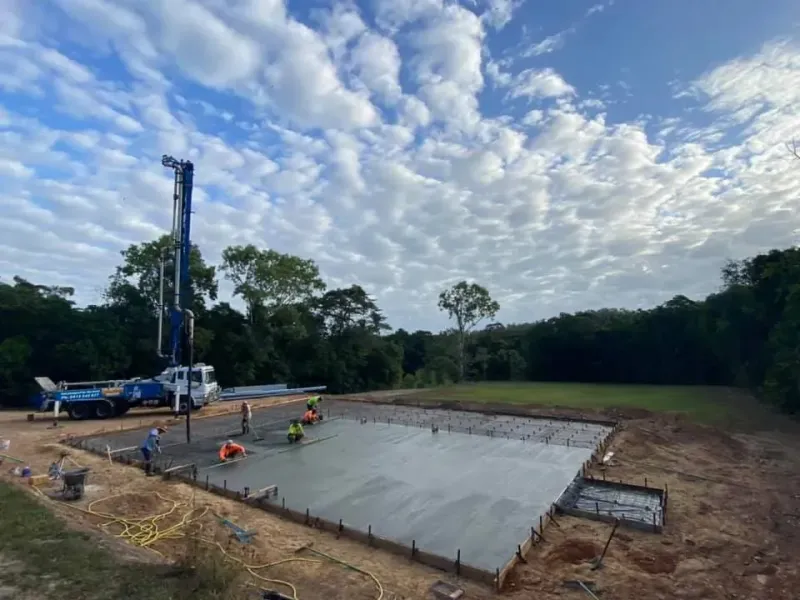
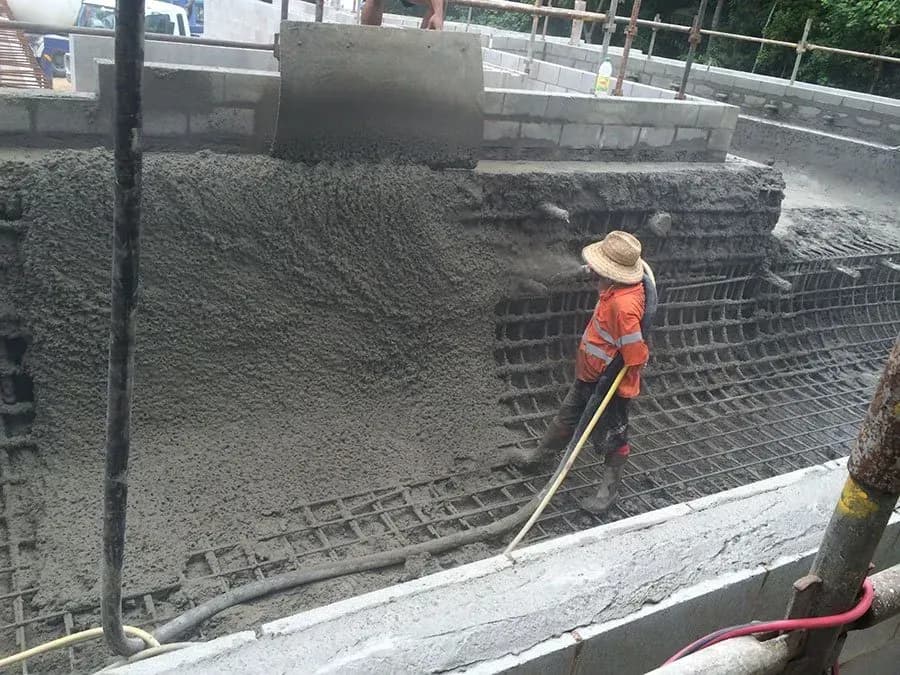
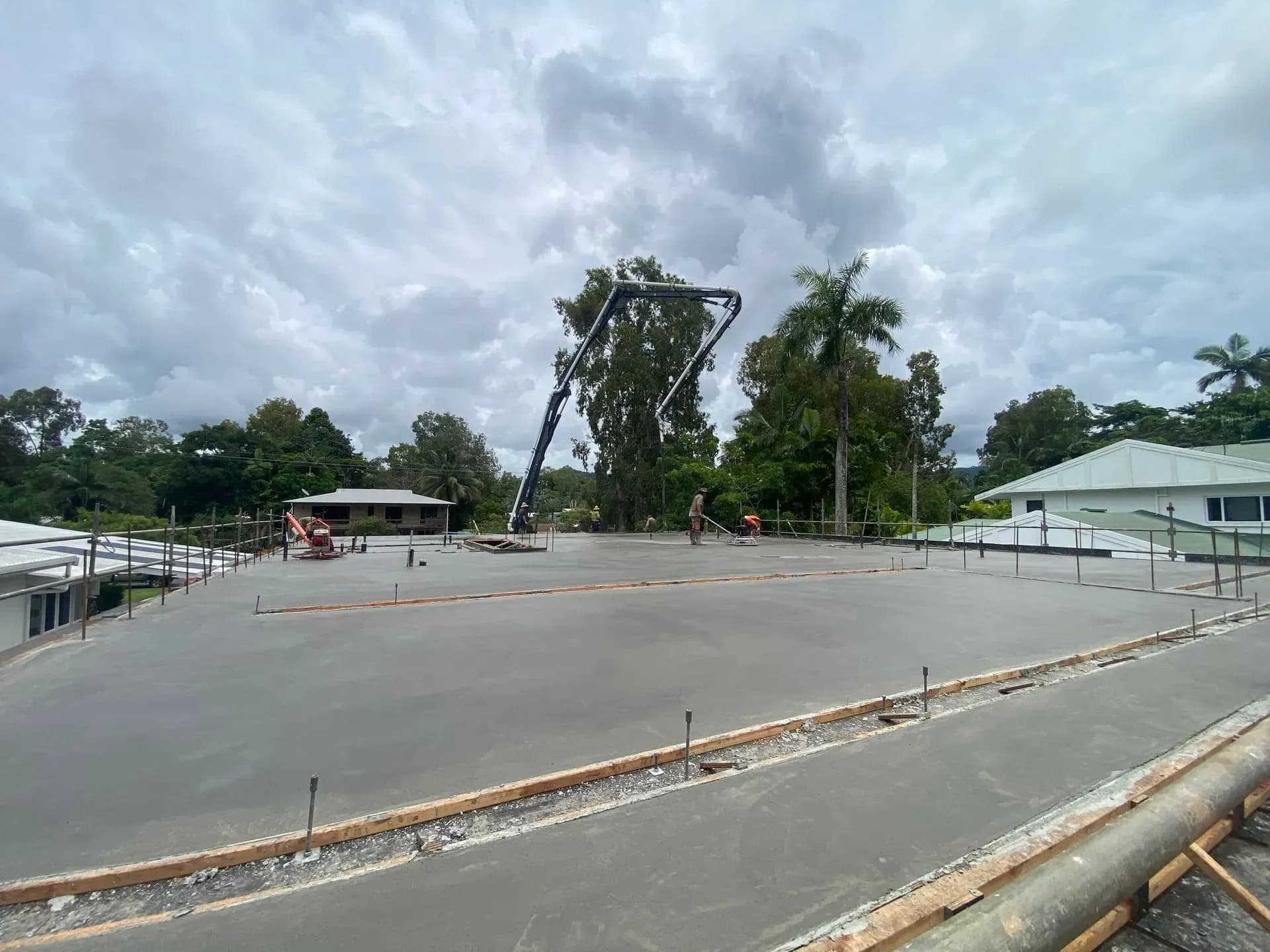
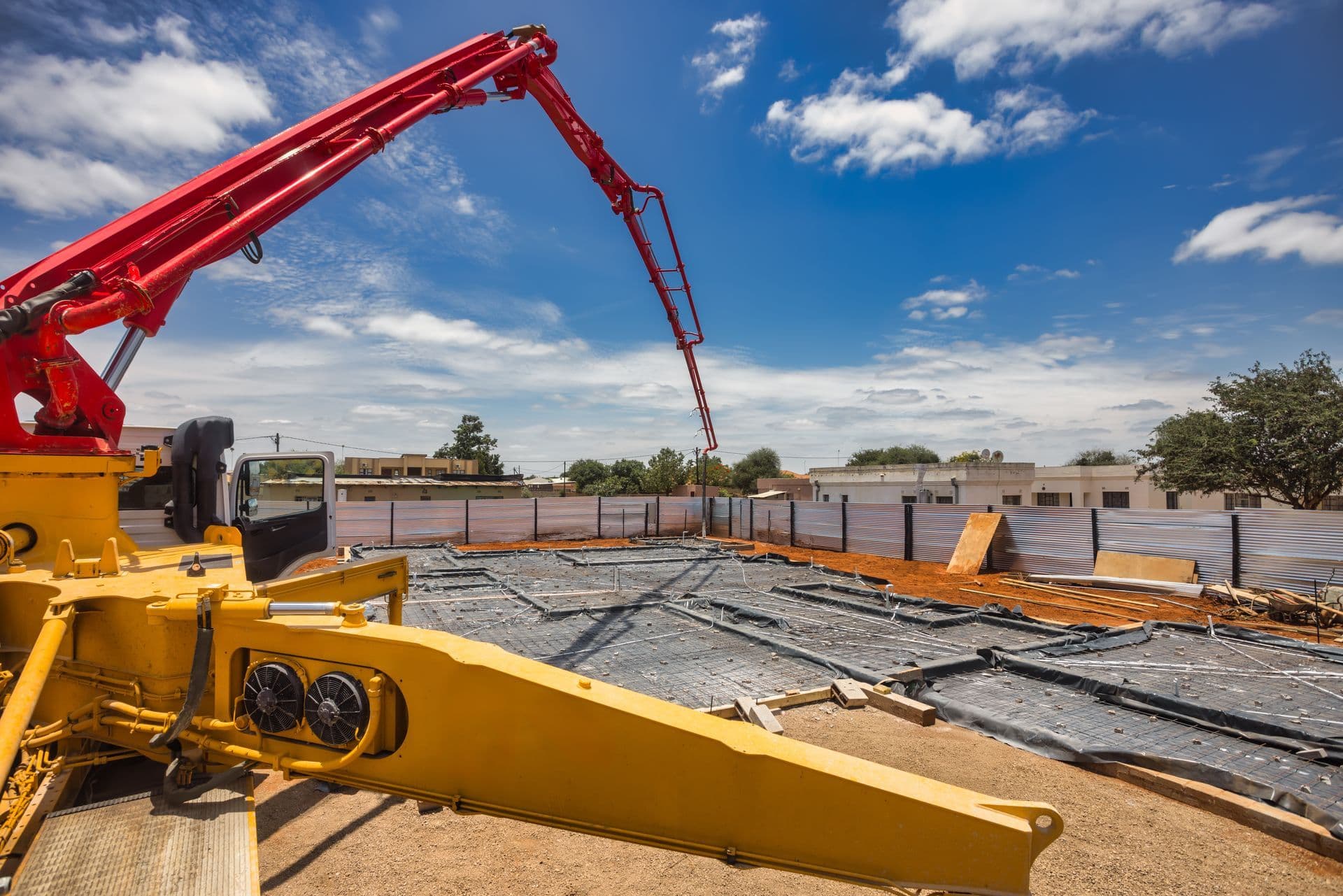
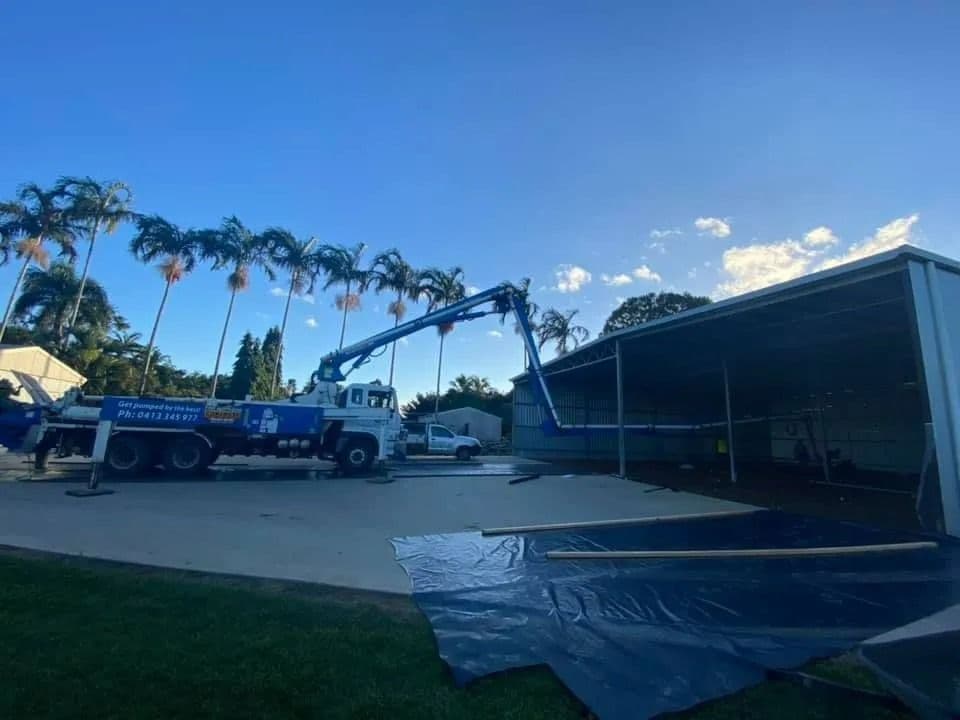
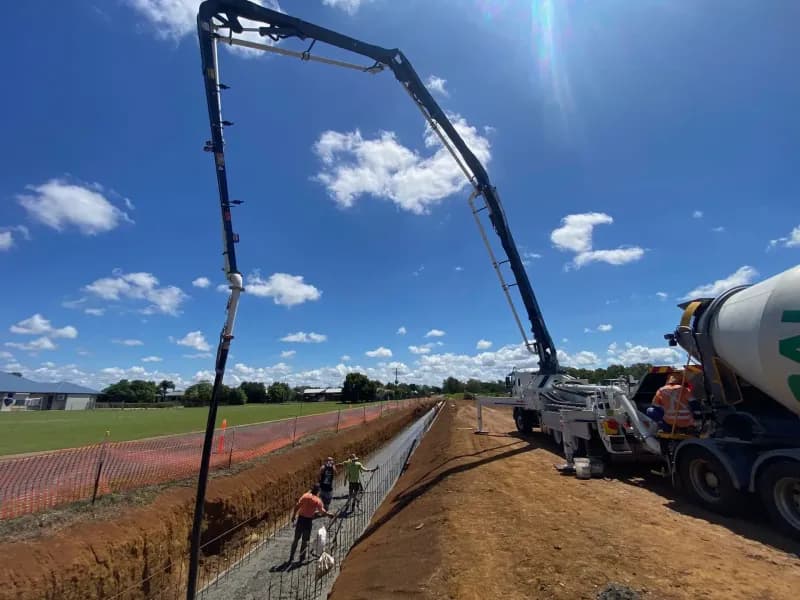
Pumping concrete in hot weather works, but the line, the trucks and the placement front all need managing. CCAA's hot weather data sheet says to keep all equipment that touches the concrete cool, naming pump lines alongside chutes and reinforcement, and to shade that equipment or spray-cool it with water when it cannot be kept cool continuously. CCAA's flatwork guide says that when pumping concrete, delivery schedules should leave enough time between loads to avoid delaying trucks. A truck waiting in the sun is using up the same window our guide to the 90 minute rule for concrete describes.
On the slab, CCAA advises keeping a minimum placement front and protecting the concrete at that front from evaporation where delays happen. CCAA's Concrete Basics says delays are more of a problem on hot and/or windy days, when concrete dries out and stiffens more quickly. CCAA says water should not be added to premixed concrete on site unless it is within the allowance for the specified water/cement ratio and slump, and our guide to pump mix concrete explains why water at the truck is not the fix.
Hot weather pour-day checklist
A hot weather pour is won or lost in the planning. Run through this list in the week before the pour and again on the morning:
- Talk to the concrete supplier early. CCAA says to consult the supplier as early as possible when hot weather is likely to be a problem, and to specify a maximum acceptable delivery temperature.
- Ask about a set-retarding admixture. CCAA's Concrete Basics says one may be added during mixing to extend working time; whether it suits the mix is the supplier's call.
- Book the first truck for the cool part of the day. CCAA suggests early morning or late afternoon, or night work where permitted, and Cement Australia recommends placing and finishing in the early morning, before air temperature and wind rise and humidity drops.
- Have forms, equipment and workers ready before the first delivery, with enough people to finish quickly.
- Put up sunshades and windbreaks where you can, and keep materials out of direct sun.
- Dampen the subgrade and forms, but do not leave water lying around.
- Check the delivered concrete with a thermometer and ask the plant for adjustments if needed.
- Keep an evaporation retarder (aliphatic alcohol) on site, apply it after screeding and floating, and re-apply it as needed after each working of the surface.
- Expect a shorter finishing time, but do not finish while bleed water is still on the surface.
- Start curing as soon as finishing is complete.
Curing in the heat: start straight away and keep it moist
Curing in hot weather should start as soon as the slab is finished and keep the surface continuously moist. CCAA's hot weather data sheet says curing is particularly important in the first day after placement and in hot or windy conditions, and lists ponding, wet hessian or cotton mats, a continuous mist spray, plastic sheeting and sprayed curing compounds as methods. CCAA's Concrete Basics warns that hosing in the morning and again at night, letting the concrete dry out in between, is no good. Water curing also helps cool the concrete, but the data sheet notes the surface must be hard enough first.
Two hot weather cautions apply. CCAA's flatwork guide says plastic sheeting used for curing should be clear or light coloured, not black, and Concrete Basics says not to apply cold water to a hot concrete surface, because the sudden cooling can cause thermal cracking. Evaporation retarders only protect the surface during finishing; CCAA is clear that they are not curing compounds, so curing still has to follow.
When to postpone a hot weather pour
Postpone a pour, or move it to a cooler time, when the heat is beyond what the site and crew can manage on the day. CCAA says the first option to weigh in hot, adverse weather is postponing, since waiting is often better than costly repairs, and Cement Australia's FAQ advice is to postpone the job until it is cooler if the temperature is over 35 degrees. Treat these as warning signs:
- The forecast is well above 30 degrees with a hot, dry wind during the hours you will be placing and finishing.
- The supplier cannot keep the delivered concrete within its temperature limit.
- There is no shade, windbreak or evaporation retarder on site, and no way to start curing straight after finishing.
- Trucks would have to wait in the sun because the forms, pump or crew are not ready for the first delivery.
- There are not enough workers to place and finish the area before it sets.
Next steps
To work out how long the pump and crew will be on site, and so how early to start, talk to us about the volume, the pump and the crew size. For driveways, house slabs and pool surrounds, see our residential concrete pumping work, or visit concrete pumping for our 31m, 28m and 20m boom pumps and line pump. We are open 24 hours, Monday to Sunday, so we can start early to beat the heat. For coastal jobs see Cairns concrete pumping, and for Mareeba, Atherton and surrounds see concrete pumping on the Tablelands. When you have a date in mind, contact us or call 0413 345 977.
Sources
- Hot Weather Concreting (data sheet), Cement Concrete & Aggregates Australia. Accessed 30 October 2026.
- Concrete Basics: A Guide to Concrete Practice, Cement Concrete & Aggregates Australia. Accessed 30 October 2026.
- Guide to Concrete Flatwork Finishes, Cement Concrete & Aggregates Australia. Accessed 30 October 2026.
- How to lay a concrete slab, Cement Australia. Accessed 30 October 2026.
- FAQs, Cement Australia. Accessed 30 October 2026.
- Climate statistics for Australian locations: Cairns Aero, Bureau of Meteorology. Accessed 30 October 2026.
- Climate statistics for Australian locations: Mareeba Airport, Bureau of Meteorology. Accessed 30 October 2026.
- Working in heat, Safe Work Australia. Accessed 30 October 2026.
- AS 1379:2026 Specification and supply of concrete (store listing), NSAI Standards Store. Accessed 30 October 2026.