
In brief
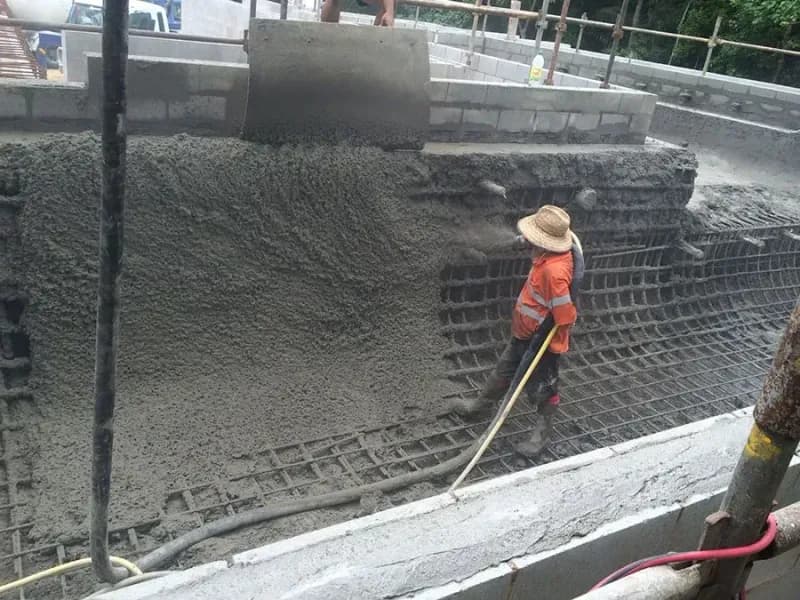
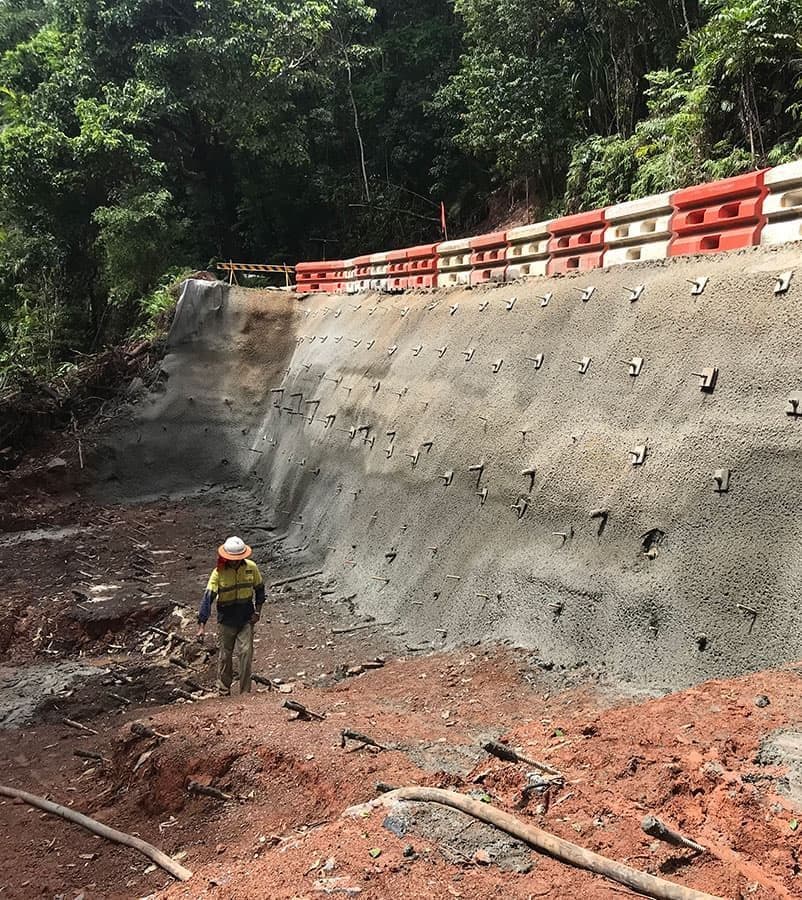
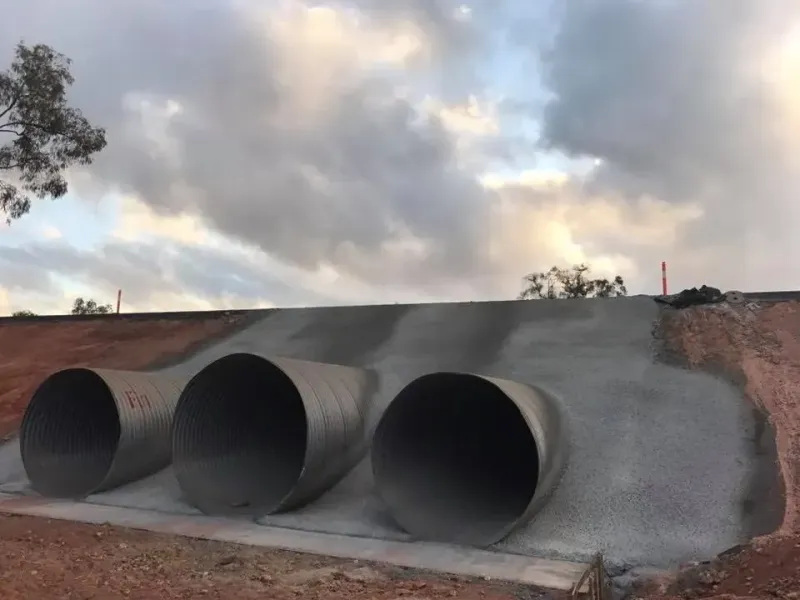
Shotcrete, also called sprayed concrete, is concrete shot through a hose and nozzle onto a slope, wall or drain. Gunite is the name for the dry-mix version. In Queensland, TMR's MRTS272 specification lists slope stabilisation and slab-on-ground drainage among its typical uses, and the drawings set the thickness, strength and reinforcement.
On this page
Shotcrete in one answer
Shotcrete is concrete that is sprayed into place rather than poured into formwork. The American Concrete Institute (ACI) describes it as a method of applying concrete projected at high velocity, primarily onto a vertical or overhead surface, where the impact of the application consolidates the concrete. Queensland's Department of Transport and Main Roads (TMR) uses almost the same words in its MRTS272 specification: shotcrete is concrete projected onto a surface at high velocity.
The concrete itself is not exotic. ACI notes that the hardened properties of shotcrete are similar to those of conventional cast-in-place concrete. What changes is the placement: according to ACI, spraying gives an excellent bond with most substrates, needs less formwork, can be more economical than conventionally placed concrete, and suits curved and thin elements in new construction and repairs. That is why sprayed concrete turns up on batters, drains and embankments, where building formwork against a sloping face would be slow and awkward.
Wet-mix and dry-mix (gunite): how the two processes differ
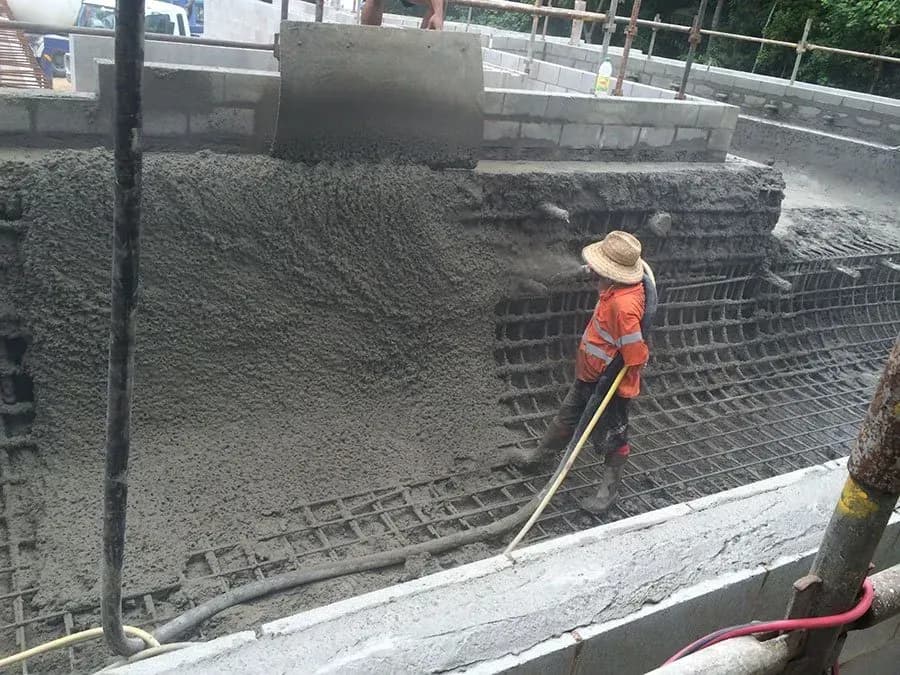
Shotcrete is the umbrella term, and gunite is one version of it: the dry-mix process. The American Shotcrete Association (ASA) explains that shotcrete covers spraying concrete or mortar by either a dry-mix or wet-mix process, while gunite refers only to the dry-mix process. According to the ASA, shotcrete was used in place of the then proprietary word Gunite, and ACI has used shotcrete to describe all sprayed concrete or mortar since at least 1967.
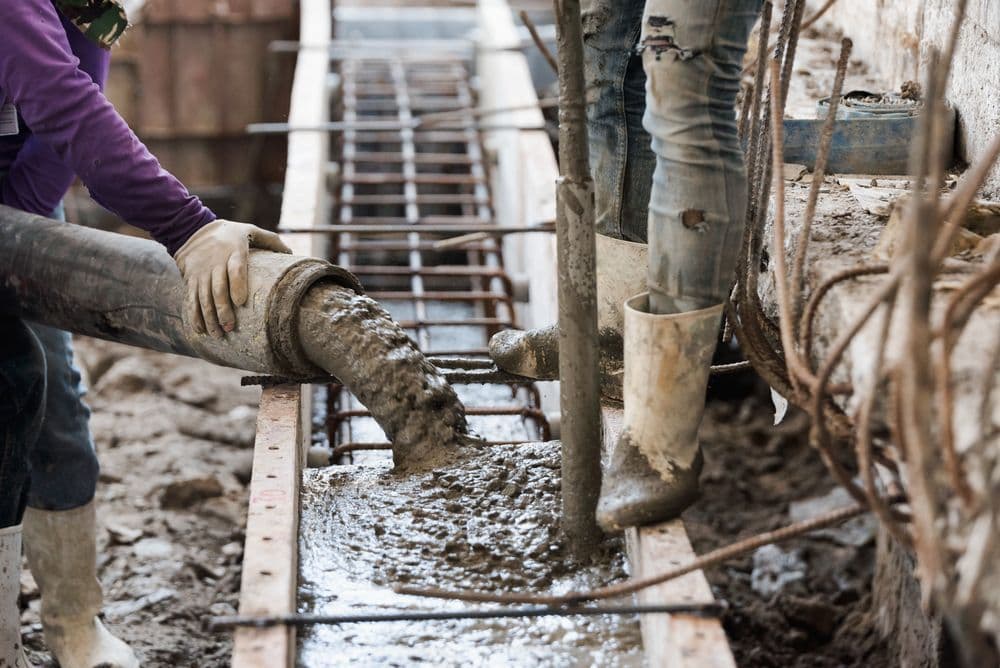
The practical difference is where the water goes in. In wet-mix shotcrete, ACI says all the ingredients, water included, are mixed before they enter the delivery hose. The ASA adds that wet-mix involves pumping a previously prepared mixture, typically ready mixed concrete, to the nozzle, where compressed air propels it onto the surface. In dry-mix, the dry materials are blown down the hose and water is added at the nozzle.
Wet-mix shotcrete compared with dry-mix shotcrete (gunite)
| Factor | Wet-mix shotcrete | Dry-mix shotcrete (gunite) |
|---|---|---|
| When water is added | Before the concrete enters the hose | At the nozzle |
| What travels down the hose | Prepared concrete, typically ready mixed, pumped to the nozzle | Dry cementitious mixture blown through the hose |
| Where mixing finishes | At the batching plant or mixer | As the material hits the surface, guided by the nozzle operator |
| Operator skill | Nozzle distance and angle still matter | ASA says it needs a very highly skilled nozzle operator, especially on thick or heavily reinforced sections |
| Typical material | Typically ready mixed concrete (ASA) | ASA says large aggregate is seldom used |
| Covered by TMR MRTS272 | Yes, the specification is written for wet-mix shotcrete | Not the subject of MRTS272 |
Sprayed vs poured: what changes on site
Spraying uses the force of the spray to compact the concrete and needs less formwork, so the work shifts from building forms to controlling the nozzle and the surface. A poured or pumped placement fills a mould; a sprayed placement builds up a layer against a prepared face. TMR's MRTS272 specification shows what that means in practice: equipment must produce a continuous, uninterrupted stream, shotcrete goes on in successive layers no thicker than 75 mm up to the design thickness, and probes or depth pins are used during spraying to monitor thickness.
Sprayed concrete compared with a poured or pumped placement
| Factor | Poured or pumped into forms | Sprayed (shotcrete) |
|---|---|---|
| How it is compacted | Placed into formwork that holds the shape | The impact of the spray consolidates the concrete (ACI) |
| Formwork | Needed for every face | Less formwork (ACI) |
| Thickness control | Set by the forms | Built up in layers of no more than 75 mm on TMR work, checked with probes or depth pins |
| Waste on the day | Spillage and washout | Rebound, which TMR requires to be removed, and overspray, which TMR requires kept off or cleaned from nearby surfaces |
| Typical use | Slabs, footings, walls, columns | Drains, batters, slope stabilisation, curved and thin elements |
Jobs sprayed concrete suits in Far North Queensland
Sprayed concrete earns its place where the surface is sloped, irregular or awkward to form. Queensland's road authority gives a useful list. TMR's MRTS272 specification names these typical applications:
- Slab-on-ground drainage.
- Slope stabilisation.
- Abutment protection.
- Retaining wall elements where the shotcrete is not the primary structural element, for example between cast-in-place piles.
Those categories line up with the spraying work we take on: road embankments, stabilisation and drainage spraying. The same specification is clear about what it does not cover: it is not intended for overhead applications, and tunnelling or other underground work needs a project-specific specification. Free-form pool surrounds are another use on residential blocks, though the shell or structure underneath is a design matter covered below.
What the engineer specifies and what the crew controls
On TMR road work, the drawings decide what the shotcrete has to be, and the spraying crew's job is to deliver it. On any other structural job it pays to work the same way. TMR's MRTS272 makes the split plain. The thickness tolerance is as shown on the drawings, fibres replace conventional reinforcement only where indicated or approved by the designer, and the concrete is supplied in accordance with AS 1379 and TMR's MRTS70 concrete specification. On TMR work the nominated slump of a shotcrete mix sits between 60 mm and 180 mm.
Before spraying starts on a TMR job, the contractor submits procedures covering surface preparation, equipment, reinforcement, spraying, finishing and curing, the mix design and the nominated nozzle operators. A trial is then run for each mix and nozzle operator at least four weeks before construction, spraying test panels at least 750 mm by 750 mm. TMR also points to the Concrete Institute of Australia's Recommended Practice: Shotcreting in Australia (2010) for guidance on materials and methods.
Who sets what on a shotcrete job
| Decision | Set by | Where it is written |
|---|---|---|
| Thickness, strength grade and reinforcement | Engineer or designer | The drawings |
| Fibres instead of steel reinforcement | Designer | The drawings or a designer's approval |
| Concrete supply | Concrete supplier | AS 1379, plus MRTS70 on TMR work |
| Layer thickness, nozzle distance and angle | Spraying crew | The approved procedure; MRTS272 caps layers at 75 mm and the angle at 30 degrees from perpendicular |
| Removing rebound and loose material | Spraying crew | MRTS272 clause 14 |
Rebound, wet surfaces and curing on a sprayed surface
Rebound is the part of the spray that does not stay put. TMR defines it as shotcrete material that bounces off the receiving surface, separate from overspray, which misses the surface altogether, and sloughing, where fresh shotcrete detaches or falls away. MRTS272 requires any shotcrete that has sagged, slumped, or is loose, porous or uncompacted to be removed rather than built into the work, and rebound material to be removed as well.
The surface matters as much as the spray. Under MRTS272, water must not be flowing across or seeping excessively from the surface to be sprayed, loose soil and gravel must be compacted and trimmed, and rock or concrete must be free of loose material, dust and oily films. Our guide to pouring concrete in the rain covers planning around weather.
Sprayed concrete still needs curing. MRTS272 says shotcrete is cured with curing compounds or water, and that curing compounds are not used where more layers of shotcrete or concrete will go on top. On TMR work, MRTS70 requires curing for at least seven days. Our how to cure concrete guide explains the methods.
Planning a spraying job: access, water, washout and timing
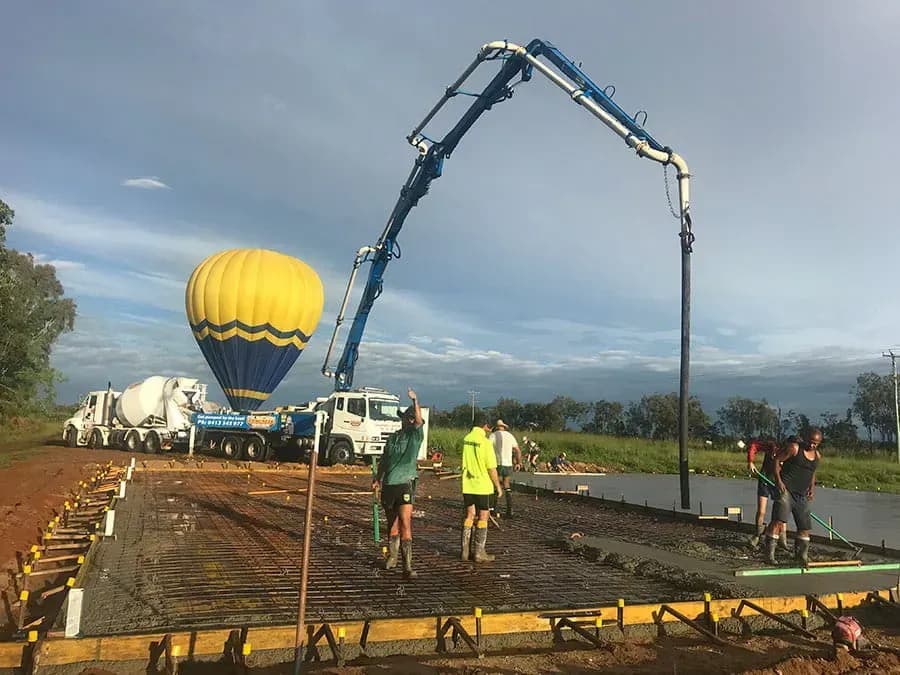
A spraying job is planned like a pumped pour, with a few extra checks for the surface. Queensland's Concrete Pumping Code of Practice 2019 lists robotic shotcrete machines among the plant involved in concrete pumping, and its warnings about hose whip cover any concrete delivery line with flexible hoses. Use this checklist before booking:
- Get the drawings or engineer's notes showing thickness, strength grade and reinforcement.
- Prepare the surface: compact and trim soil batters, clean rock or concrete, and deal with flowing or seeping water.
- Protect nearby surfaces such as fences, walls and paving from overspray, or plan to clean them after spraying.
- Order a pumpable mix from the supplier, as the Code of Practice says other concrete can block the line and cause hose whip.
- Keep people clear of unrestrained flexible hoses, since hose whip can occur when a line is pressurised from the pump or with compressed air.
- Make sure the line hand has suitable eye protection.
- Set up a clearly defined washout area that meets environmental and local council requirements; see our concrete washout guide.
Concrete spraying with Far Northern Concrete Pumping
Yes, we spray as well as pump. Far Northern Concrete Pumping offers concrete spraying for free-form pool surrounds, road embankments and environmental stabilisation work, and on civil jobs we also provide drainage spraying. We have operated from Mareeba since 2014 with 31m, 28m and 20m boom pumps and a line pump, and our operators are licensed and high-risk certified. We cover Cairns, the Tablelands, Cape York and south through Innisfail.
Next steps
Wet-mix shotcrete usually starts as ready mixed concrete that has to travel through a pump and hose, so the mix matters. Our guide to pump mix concrete explains what to tell the batching plant, and how a concrete pump works covers the machine that feeds the nozzle. For choosing between machines, see line pump vs boom pump, our equipment and our concrete pumping services. When you know the area, the surface and the volume, contact us for a quote.
Sources
- What is shotcrete and when is it used?, American Concrete Institute. Accessed 30 October 2026.
- What is the difference between shotcrete and Gunite?, American Shotcrete Association. Accessed 30 October 2026.
- Technical Specification MRTS272 Shotcrete for Aboveground Applications (November 2020), Queensland Department of Transport and Main Roads. Accessed 30 October 2026.
- Technical Specification MRTS70 Concrete (July 2022), Queensland Department of Transport and Main Roads. Accessed 30 October 2026.
- Concrete Pumping Code of Practice 2019, Workplace Health and Safety Queensland. Accessed 30 October 2026.