




In brief
Adbri Masonry's North Queensland guide puts a standard 200 series Besser block at about 0.66 m3 of grout per 100 blocks, and lists 0.100 m3 per square metre of wall as a separate figure. Tell the supplier the concrete is for filling blockwork, have the cores cleaned and the clean-outs closed before the pump arrives, and fill tall walls in stages.
On this page
Core filling a block wall: the short answer
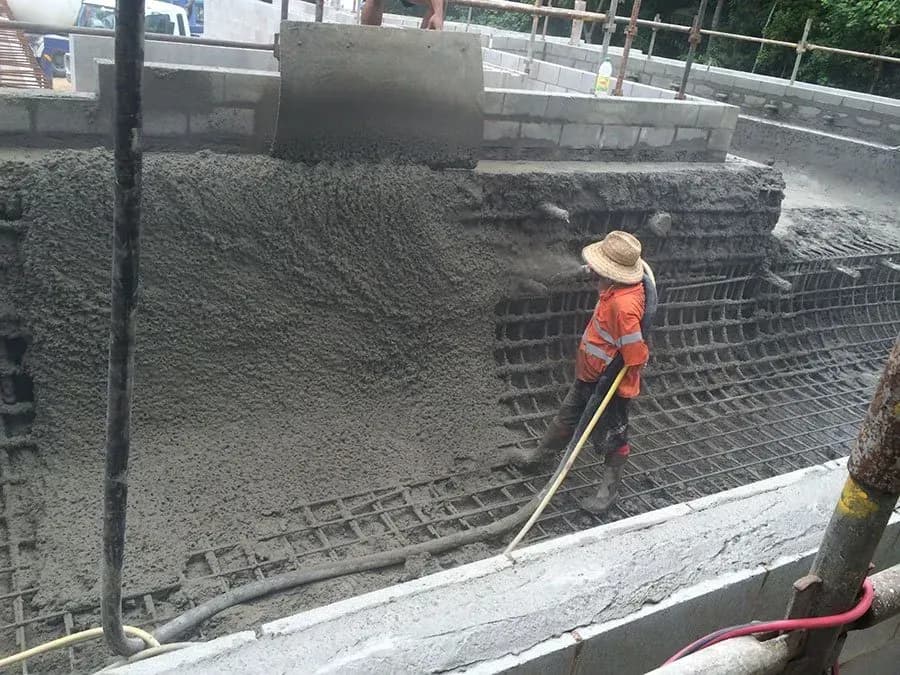
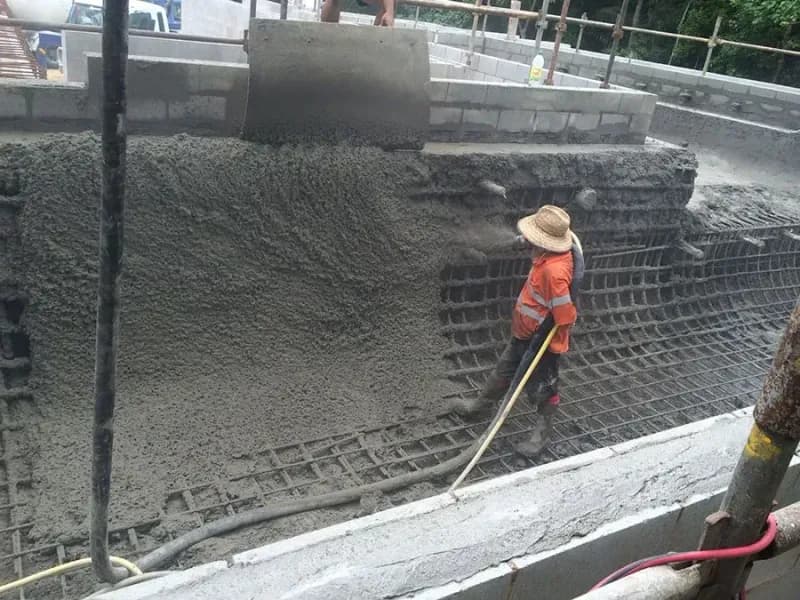
Core filling a block wall means filling the hollow cores of the concrete blocks with grout once the wall is laid and the steel is in. National Masonry describes grout as highly workable concrete, and says it can be mixed on site and poured from buckets into hoppers on top of the wall or, for larger jobs, delivered by transit mixer and pumped into the cores using a small nozzle on the hose. The quantity comes from the block maker's own table: Adbri Masonry's North Queensland guide lists about 0.66 m3 of grout for every 100 standard 200 series blocks. Everything structural about a core filled wall, including the grout specification, the reinforcement and how high each lift can go, belongs to the engineer and the block manufacturer. This guide covers the practical side of a pumped core fill: working out the volume, ordering it, getting the wall ready for the pump, and what happens on pour day. Block fills are on the list of work Far Northern Concrete Pumping pumps.
What a cored concrete block is: hollow cores for steel and grout
A cored concrete block is a hollow masonry block, often called a Besser block, with open vertical cores running through it. National Masonry explains that concrete blocks in 140, 190 and 290 mm widths have large cores so steel reinforcing rods can be placed in them and grout poured or pumped in around the steel. How much of the wall gets filled depends on the design. National Masonry says a wall reinforced with bars at 800 mm centres or less and fully grouted is called reinforced masonry. A partially reinforced wall is only grout filled where the reinforcement is placed, usually in bond beams and in the vertical cores holding steel. That difference changes the order a lot: a fully grouted wall fills every core, while a partially reinforced one fills only some. National Masonry also states that all reinforced walls must be designed by a structural engineer, so the plans will show which cores are filled.
How much concrete a block wall takes: about 0.66 m3 per 100 standard 200 series blocks
A standard 200 series block wall takes about 0.66 m3 of grout per 100 blocks, according to Adbri Masonry's North Queensland Besser block guide, which also lists about 0.100 m3 per square metre of wall. The two columns are separate figures and give slightly different totals for the same wall, so work from whichever one matches how you are measuring. The Concrete Masonry Association of Australia says block makers usually publish a "blocks filled per cubic metre" table and to ask your supplier for it, because core sizes differ between products. The table below repeats Adbri Masonry's North Queensland figures, which are approximate and apply to those blocks only.
Volume of grout used in filling cores, Adbri Masonry North Queensland Besser blocks (manufacturer's approximate figures)
| Block | Per m2 of wall | Per 100 blocks | Blocks filled per m3 |
|---|---|---|---|
| 15.01 / 15.42 (150 series) | 0.054 m3 | 0.43 m3 | About 220 |
| 20.01 / 20.42 (200 series) | 0.100 m3 | 0.66 m3 | About 150 |
| 20.48 H block (200 series) | 0.100 m3 | 0.80 m3 | About 120 |
| 30.48 (300 series) | 0.180 m3 | 1.44 m3 | About 69 |
Two worked examples show the sums. A fully filled 200 series wall 10 m long and 1.6 m high is 16 m2, and 16 x 0.100 gives about 1.6 m3. A job of 300 standard 200 series blocks is 3 x 0.66, about 2.0 m3, while 300 H blocks is 3 x 0.80, or 2.4 m3. On a partially reinforced wall, count only the blocks whose cores are being filled. Other makers' tables come out close but not identical: National Masonry's design guide lists about 150 of its 20.01 standard blocks and about 125 of its 20.48 H blocks per cubic metre of grout, and 50 of its 40.925 pier blocks. Use the table for the block on your plans. For slabs and footings poured at the same time, our guide to how much concrete you need covers rectangular volumes.
Ordering core fill: tell the supplier it is for filling blockwork
When ordering core fill, tell the concrete supplier the mix is for filling blockwork and that it will be pumped. Adbri Masonry's Versaloc brochure advises using ready-mixed core fill where possible and specifying, when ordering, that it is for filling blockwork. Holcim says that to design a mix it needs to know the placement method, such as a pump, the type of pump and the size and length of the line. You or your builder order the concrete from the premix supplier; we supply the pump in between. The grade itself is not a site decision. National Masonry says the correct grout specification is critical to achieving the structural design of a reinforced wall, and lists compliance with AS 3700 Clause 10.7 and a pouring consistency that fills the cores completely. The Concrete Masonry Association of Australia adds that grout is not mortar: it must flow freely to surround the steel and completely fill the cores.
- The grout specification from the engineer's drawings or the block manufacturer.
- That the concrete is for filling blockwork, and the block series being filled.
- The volume, worked out from the block maker's table.
- That it will be pumped, plus the pump type and the size and length of the line (ask us for these when you book).
- The delivery timing, if the wall will be filled in stages.
Our guide to pump mix concrete explains what a supplier changes in a mix so it travels through a pump line.
Why a pump suits core filling: the grout goes in through a small nozzle
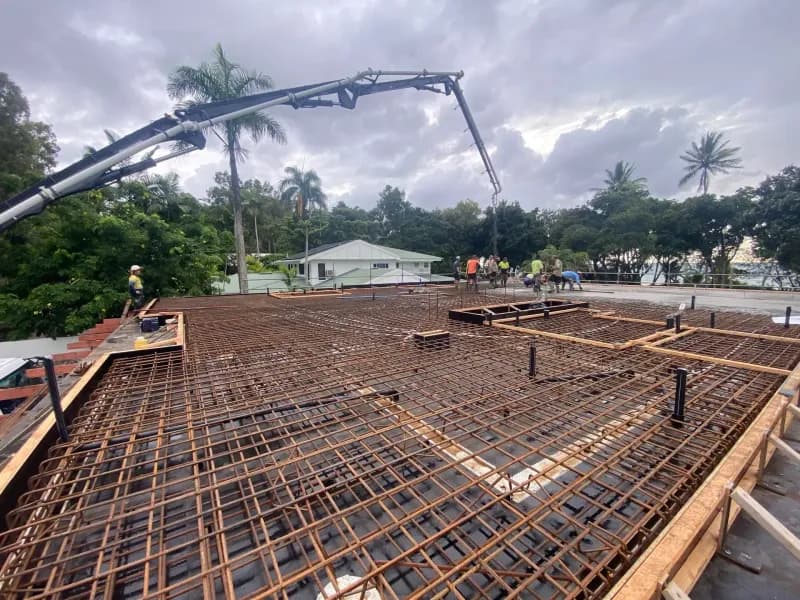
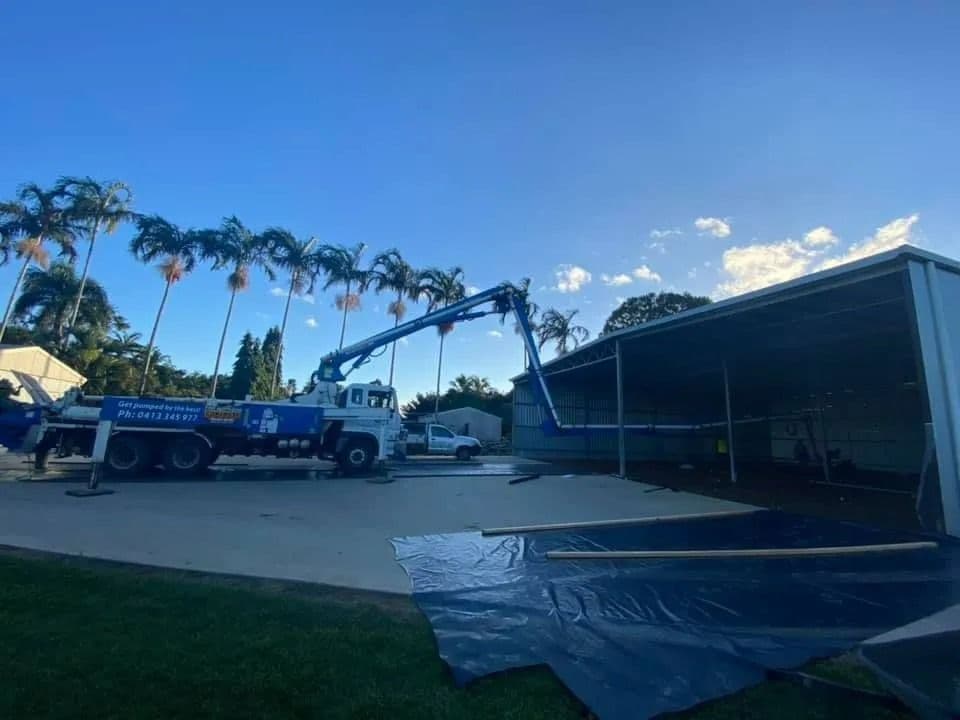
A concrete pump suits core filling because the grout has to go into narrow cores along the top of the wall, and a hose with a small nozzle can be moved from core to core along the top of the wall. National Masonry describes exactly that for larger jobs: grout delivered by transit mixer and pumped into the cores through a small nozzle on the hose, in place of buckets and hoppers. A line pump uses flexible hoses that work through tight spaces, and suits residential and small commercial jobs, which fits many block walls on tight sites. As well as our standard line pump, we run a compact high-pressure line pump for hard-to-reach pours. Where the wall is high or the truck cannot get close, a boom pump places concrete through a folding arm that can reach over a house, fence or landscaping. We run 31 m, 28 m and 20 m boom pumps. We pump block fills and structural walling on commercial jobs as well as homes. Our line pump vs boom pump guide compares the two set-ups.
Before the pump arrives: clean cores, steel tied, clean-outs closed
The wall has to be ready before the pump is booked to start. National Masonry's design guide sets out the sequence for its core-fill blocks, and Adbri Masonry's North Queensland range includes a 200 series clean out block and clean out tile.
- Knock off mortar dags: National Masonry has a steel rod pushed down each core to knock off mortar projecting into it and to break up mortar dropped onto the footing.
- Clear the debris: the cores are hosed or swept out from the bottom of each core through the clean-out space.
- Tie the steel: the vertical steel rods are tied to the starter bars.
- Close the clean-outs: the clean-out blocks are covered with formwork, ready for grouting. On low walls, National Masonry describes leaving a gap in the mortar bed at the bottom of each core and hosing out the dropped mortar before it sets.
- Cool the blocks on hot days: National Masonry says hot weather may call for hosing the cores with water to stop the grout flash-setting, finished at least 30 minutes before the grout goes in.
- Book any inspection your engineer or certifier wants before the cores are filled, because the steel cannot be seen afterwards.
Pour day: fill in lifts and clean the wall as you go
Pour day for a block wall is usually staged, because fresh grout pushes hard on the bottom of the cores. National Masonry says lifts of more than 1.2 metres should not be grouted in one pour, and that above 1.2 metres it is preferable to fill the cores in two stages at least 30 minutes apart. For its 150 series blocks it reduces lifts to 800 mm, or four courses, so no voids are left. Adbri Masonry strongly recommends a maximum filling height between pours of 1.8 m, or nine courses, for its Versaloc walls. These are each manufacturer's figures for its own blocks; your engineer's lift heights come first. The same pressure forces water out through the face of the wall. For its Designer Range and face blocks, National Masonry says seepage must be cleaned off and spills cleaned before they set, and it says every core-filled wall must be cleaned thoroughly straight after filling so lime leaching from the core fill does not stain the blockwork. Have a hose and brushes ready before the first lift.
How long the whole job takes depends on the volume, the number of lifts and the waits between them; our guide to how long a concrete pour takes covers the other factors.
Common problems on core fill pours
The table below pairs each common problem with what the manufacturer or WorkSafe Queensland says about preventing it.
Common core fill problems and how the sources say to prevent them
| Problem | Likely cause | Prevention |
|---|---|---|
| Cores not filling to the bottom | Mortar dags and droppings in the cores | Rod and clean every core through the clean-outs before the pour (National Masonry) |
| Pump line blocks | A mix that is not a pumpable mix as specified by the supplier | Only pump a pumpable mix as specified by the supplier; WorkSafe Queensland warns other concrete can block the line and cause hose whip |
| Lumps stopping the nozzle | Contaminating lumps in the grout | Adbri Masonry says grout should be free of lumps larger than 15 mm, which may need a screen over the pump hopper |
| Hose blockage at the wall | A kinked discharge hose | WorkSafe Queensland notes a kinked flexible hose can block, depending on the mix design and aggregate size |
| Voids in the wall | Lifts too high for the block | Fill in the stages the engineer and manufacturer set (National Masonry: 800 mm lifts for 150 series) |
| Stained face blockwork | Seepage and spills left to set | Clean the wall straight after filling (National Masonry) |
Our guide to concrete pump blockages covers line blockages in more detail.
Compaction, grade and lift heights come from the engineer
Whether core fill is vibrated, rodded or simply poured is part of the engineer's specification, and this guide does not set a method. What the industry sources agree on is the result the grout must achieve. The Concrete Masonry Association of Australia says grout must be of pouring consistency because filling the cores matters more than high grout strength. National Masonry's specification calls for a pouring consistency that fills the cores completely and surrounds the reinforcement without the mix separating. Adbri Masonry describes a cohesive mix as one with no tendency to segregate when pumped down into the wall. If your drawings say how the grout is to be compacted, follow them; if they do not, ask the engineer before pour day rather than deciding on site.
Next steps
If you are still choosing a pump for the wall, our line pump vs boom pump guide compares access, reach and set-up. For round pier holes on the same job, see how much concrete for post holes. Far Northern Concrete Pumping is based in Mareeba and pumps block fills for commercial and residential jobs across Cairns and the Tablelands. See our equipment, then contact us or call 0413 345 977 with the location, the type of pour and the volume your concrete supplier has quoted.
Sources
- Besser Block and Brick Guide: North Queensland, Adbri Masonry. Accessed 30 October 2026.
- Versaloc Walling System brochure, Adbri Masonry. Accessed 30 October 2026.
- Masonry Blocks and Bricks Design Guide: South QLD and NSW, National Masonry. Accessed 30 October 2026.
- Technical FAQs, Concrete Masonry Association of Australia. Accessed 30 October 2026.
- 5 Essential Things You Need to Know When Ordering Premixed Concrete, Holcim Australia. Accessed 30 October 2026.
- Concrete Pumping Code of Practice 2019, WorkSafe Queensland. Accessed 30 October 2026.
- Design Manual D2: Site Regrading (FNQROC Development Manual), Far North Queensland Regional Organisation of Councils. Accessed 30 October 2026.
- Fences & landscaping, Cairns Regional Council. Accessed 30 October 2026.