
In brief
A 300 mm hole holds about 0.07 m3 (71 litres) of concrete per metre of depth, and a 600 mm hole about 0.28 m3. Cement Australia says about 110 bags of its 20 kg Concrete Mix make one cubic metre, so ten fence posts take about 29 bags while twenty house piers take about 462.
On this page
The formula for a round hole: 3.14 x radius x radius x depth
The volume of a round post hole or pier hole is pi (about 3.1416) x radius x radius x depth, which is the formula for a cylinder. Work in metres and the answer comes out in cubic metres (m3), the unit premix concrete is ordered in. The radius is half the diameter. If the plans give the diameter in millimetres, convert it first: a 300 mm hole has a radius of 0.15 m. If you prefer to start from the diameter, 0.785 x diameter x diameter x depth gives the same answer.
- Convert the hole diameter from millimetres to metres (300 mm is 0.3 m) and halve it for the radius (0.15 m).
- Square the radius: 0.15 x 0.15 = 0.0225.
- Multiply by 3.1416: 0.0225 x 3.1416 = 0.0707 m3 for every metre of depth.
- Multiply by the depth of concrete in metres: a 900 mm deep hole gives 0.0707 x 0.9 = 0.064 m3, or about 64 litres.
- Multiply by the number of holes, then subtract any post that stands in the concrete.
Rectangular slabs, paths and driveways use length x width x depth instead, and our guide to how much concrete you need covers those with a calculator.
Concrete per metre of depth, by hole diameter
The quickest way to size a round hole is to read the volume per metre of depth from a table and multiply by your actual depth. The table below is pure geometry for an empty, perfectly round hole. The bag column uses Cement Australia's published figure of about 110 x 20 kg bags of its Concrete Mix per cubic metre, so it only applies to that product. A 600 mm diameter hole, a size people often ask about, holds about 0.28 m3 per metre of depth, so a 600 mm hole that is 600 mm deep takes about 0.17 m3. The figures climb quickly as the diameter grows: going from a 300 mm to a 450 mm hole more than doubles the concrete, because the volume rises with the square of the diameter.
Concrete in a round hole per metre of depth (no post, no allowance)
| Hole diameter | Volume per metre of depth | Litres per metre | Approx. 20 kg Concrete Mix bags per metre |
|---|---|---|---|
| 200 mm | 0.031 m3 | 31 L | 3.5 |
| 250 mm | 0.049 m3 | 49 L | 5.4 |
| 300 mm | 0.071 m3 | 71 L | 7.8 |
| 350 mm | 0.096 m3 | 96 L | 10.6 |
| 400 mm | 0.126 m3 | 126 L | 13.8 |
| 450 mm | 0.159 m3 | 159 L | 17.5 |
| 500 mm | 0.196 m3 | 196 L | 21.6 |
| 600 mm | 0.283 m3 | 283 L | 31.1 |
Worked examples: fence posts, deck piers and house piers
These worked examples run the whole sum from hole size to order. The hole sizes are examples chosen to show the arithmetic, not recommendations, so use the sizes on your own plans. Each example adds 10% (the allowance Hunter Readymixed Concrete suggests for small projects) and rounds premix up to the next 0.1 m3. For fence posts, the post takes up room in the hole, which is why Cement Australia's post hole calculator asks for the post size as well as the hole size. A 100 mm square post standing in 600 mm of concrete displaces 0.1 x 0.1 x 0.6 = 0.006 m3 per hole. Concrete piers have no post in them, so nothing is subtracted.
Round hole worked examples (example sizes, 10% allowance, Concrete Mix at about 110 bags per m3)
| Job | Example hole | Per hole | Holes | Total | Plus 10% | Bags or order |
|---|---|---|---|---|---|---|
| Fence posts | 250 mm x 600 mm deep, less a 100 mm square post | 0.0235 m3 | 10 | 0.235 m3 | 0.258 m3 | About 29 bags |
| Deck piers | 400 mm x 900 mm deep | 0.113 m3 | 12 | 1.357 m3 | 1.493 m3 | About 165 bags, or order 1.5 m3 |
| House piers | 450 mm x 1,200 mm deep | 0.191 m3 | 20 | 3.817 m3 | 4.199 m3 | About 462 bags, or order 4.2 m3 |
Measure the depth of concrete, not the depth you dig. Cement Australia's fence post guide has you dig an extra 10 cm and place 10 cm of gravel in the bottom of the hole for drainage, so a post hole dug 700 mm deep holds 600 mm of concrete.
How many 20 kg bags per post hole: about 3 for a 250 mm fence post hole
A 250 mm fence post hole with 600 mm of concrete and a 100 mm square post needs about 2.6 bags of Cement Australia's 20 kg Concrete Mix, so buy 3 bags per hole. That figure comes from the hole volume (0.0235 m3) multiplied by Cement Australia's yield of about 110 bags per cubic metre. Its online calculator rounds the bag count up to the nearest whole bag in the same way. The 110 bag figure is for Concrete Mix only, so for any other product check the manufacturer's stated yield for that product. Product choice matters too. Cement Australia describes Post Set Concrete as suited to non-structural posts such as fence posts, letterboxes and clothes lines, and states that Rapid Set Concrete is not designed for any structural application. Its Concrete Mix lists footings, posts and uprights for pergolas among its uses.
Cement Australia 20 kg products for posts (from the manufacturer's product pages and fence post guide)
| Product | How it goes in | Set and supports |
|---|---|---|
| Rapid Set Concrete | Dry mix poured into measured water in the hole, starting with 2.0 L per 20 kg bag | Initial hardening within 15 minutes; supports off after at least 1 hour; not for structural use |
| Post Set Concrete | Mixed in a wheelbarrow first, then placed | Non-structural posts; supports left at least 24 hours |
| Concrete Mix | Mixed in a wheelbarrow or concrete mixer first, then placed | Supports left at least 24 hours; wait 3 days before fixing anything to the post |
For small jobs, allow about 10% extra: real holes are not perfect cylinders
Hunter Readymixed Concrete suggests allowing 10% extra concrete on small projects, to cover small estimating errors and concrete left in the hopper of a concrete pump. Dug holes are rarely the neat cylinders the formula assumes, and any extra width or depth fills with concrete. Holcim says estimates should be based on site measurements rather than drawings or plans, and lists over excavation and uneven sub-grade levels among the things an order should allow for. Hunter also makes the cost point plainly: it is far more economical to order a little extra than a small additional quantity to finish the job. Check whether a calculator has already added an allowance before you add yours. Cement Australia's post hole calculator, for example, states that its answer includes no allowance for wastage.
- Measure the holes on site once they are dug, rather than relying on the sizes drawn on the plans.
- Measure depth to the top of any gravel, not to the bottom of the dig.
- Count every hole on the plan, including any extra ones for gates or corners.
- Add the allowance after you total the holes, then round premix up to the next 0.1 m3.
Bags or a premix truck: many pier holes add up fast
Bag counts climb quickly once a job moves from posts to piers. The ten fence posts in the worked example need about 29 bags of Concrete Mix, while the twenty house piers need about 462. Cement Australia itself suggests renting a mechanised post hole auger and a concrete mixer when setting a large number of posts. At the premix end, one cubic metre of concrete is 1,000 litres and weighs about 2,400 kg according to Hunter Readymixed Concrete, so the 4.2 m3 pier order is roughly 10 tonnes of concrete to move from the truck to the holes. Hunter also says premix can be ordered in multiples of 0.1 m3, which is why the examples round up to the next 0.1 m3. Holcim notes that plus or balance loads are subject to truck availability and may incur additional fees, which is another reason to get the volume right before you order. Our guide to concrete truck sizes covers how much a load carries.
Pumping concrete into pier holes: yes, with the pump kept back from the holes
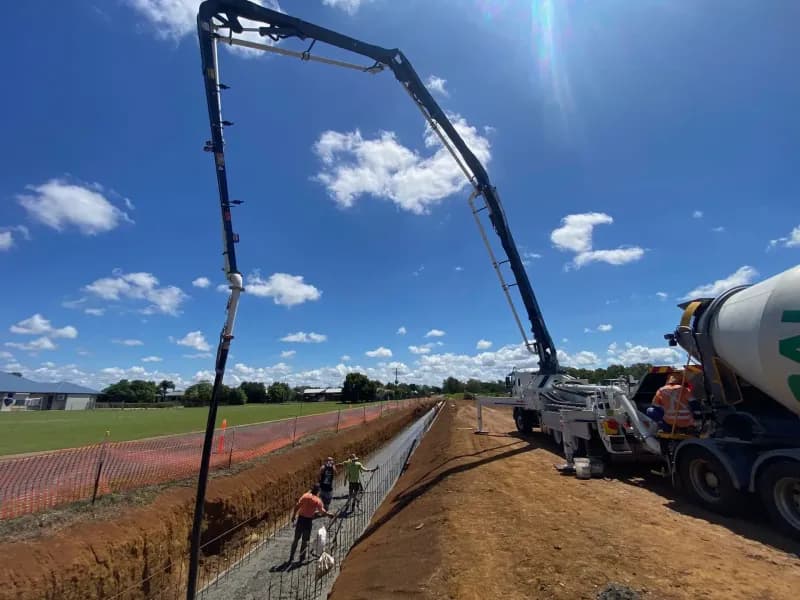
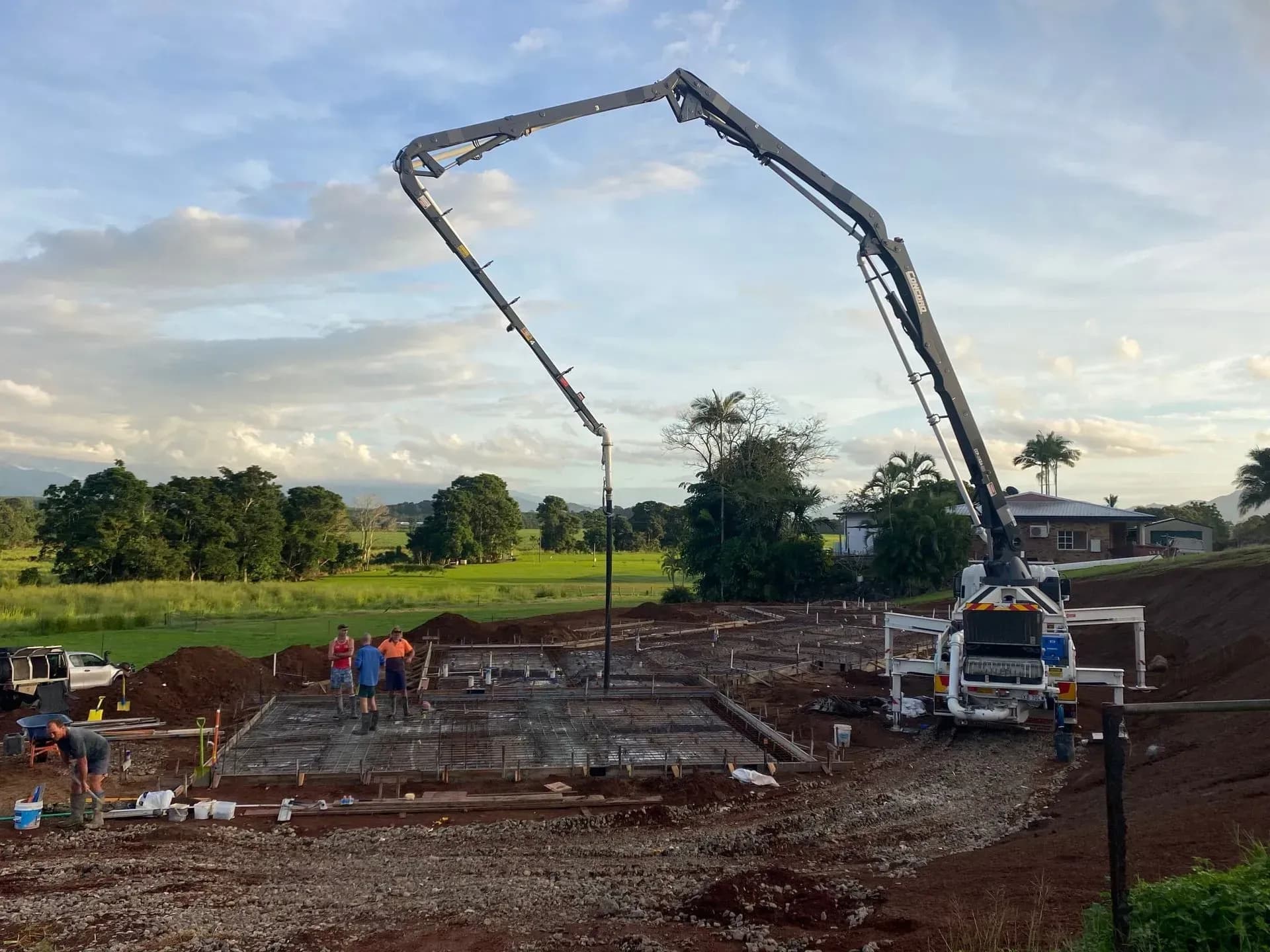
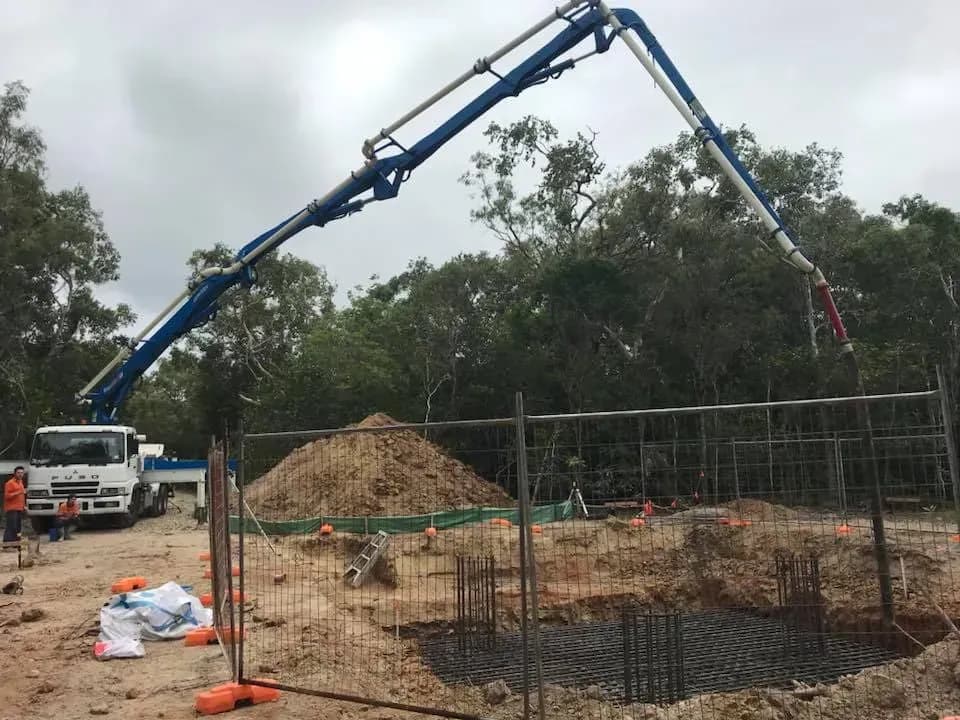
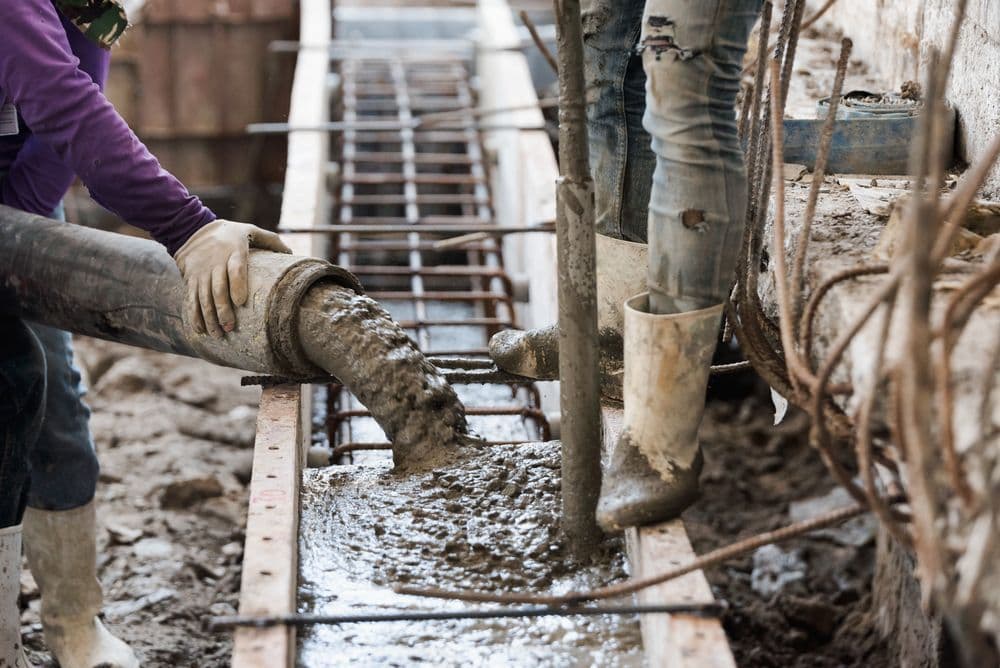
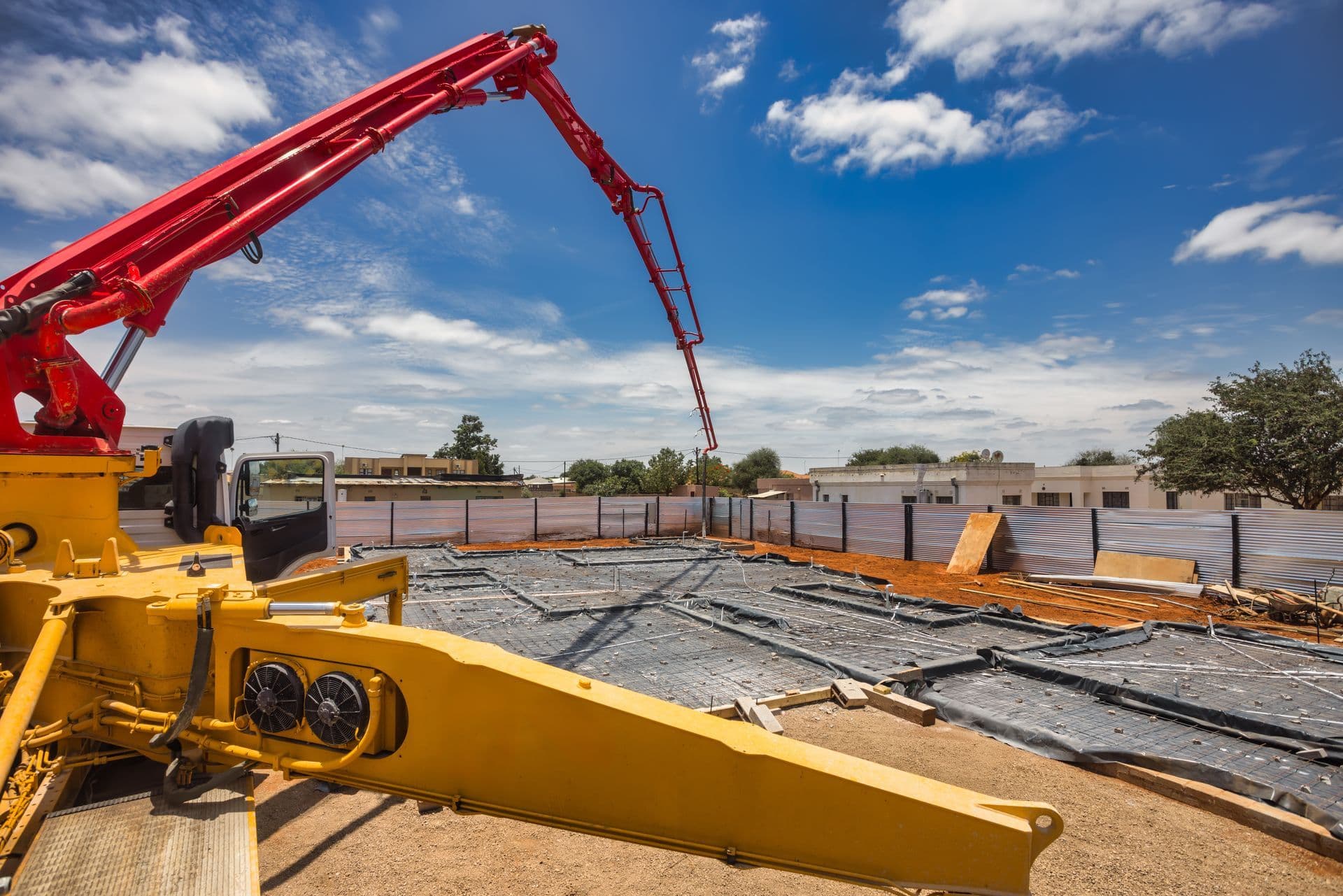
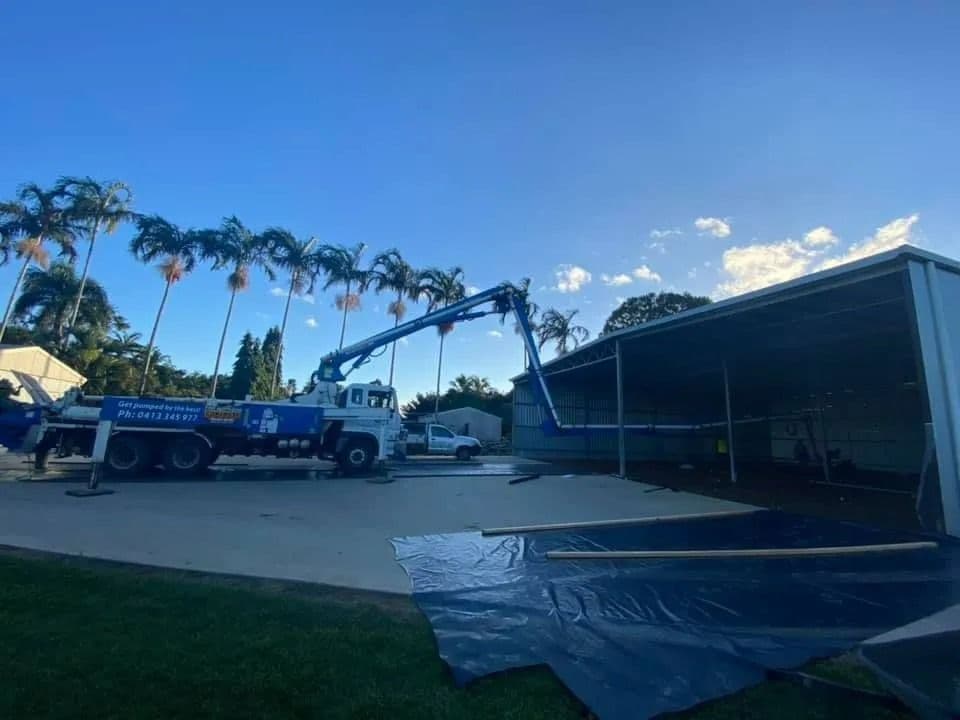
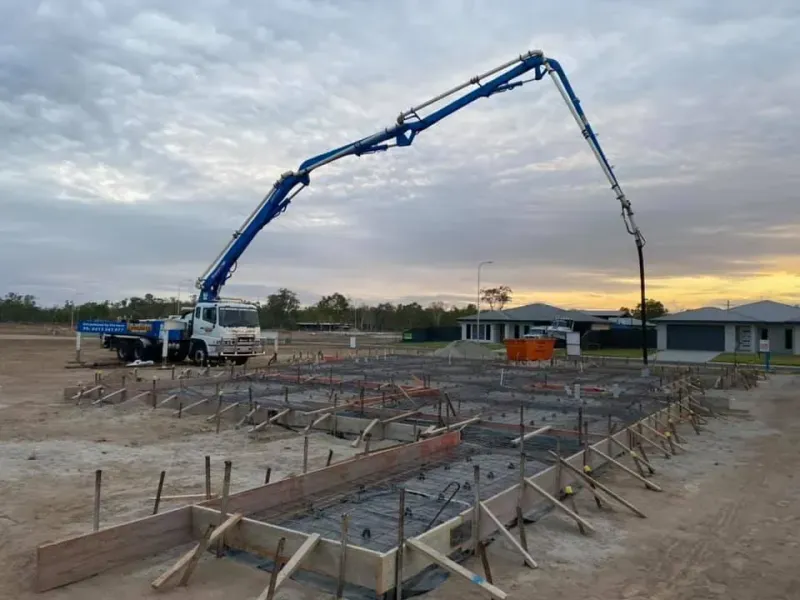
Concrete can be pumped into pier holes. A line pump delivers concrete through flexible hoses that suit tight spaces and residential jobs, and a boom pump places it from an arm. Our operators have access to a line pump and 31 m, 28 m and 20 m boom pumps, and we pump residential foundations and footings. Open holes change where the pump can go. WorkSafe Queensland's concrete pumping code of practice says the weight of the pump and its load can affect the stability of an excavation wall, and that the pump should not be positioned over or adjacent to excavations, trenches or holes in the ground. Tell us where the holes are when you book. Tell your concrete supplier too: Holcim says it needs to know the placement method, the type of pump and the size and length of the line to design the mix. Our line pump vs boom pump guide explains which suits your access.
Who sets the hole size: your plans or engineer, not a calculator
The diameter and depth of pier and footing holes come from your plans or your engineer; this guide only turns sizes you already have into volume. Cement Australia makes the same point on its post hole calculator: hole size depends on the type of post, your soil conditions and the planned load on the post, and if you are unsure you should consult the relevant expert. For house piers, deck footings and anything holding up a structure, the hole size is part of the engineer's or designer's specification, so take it from the documents rather than from a rule of thumb.
Next steps
Once you have a volume, the next question is usually what the pump will cost. Our concrete pump hire cost guide walks through what drives the price, and preparing your site for a concrete pump covers truck and pump access on the day. Far Northern Concrete Pumping is based in Mareeba, and we pump residential foundations and footings across the Tablelands and Cairns. See how our concrete pumping service works, then contact us or call 0413 345 977 with the location, the type of pour and the volume your concrete supplier has quoted.
Sources
- Concrete for post holes calculator, Cement Australia. Accessed 30 October 2026.
- How to set a fence post, Cement Australia. Accessed 30 October 2026.
- FAQs, Cement Australia. Accessed 30 October 2026.
- Concrete Mix, Cement Australia. Accessed 30 October 2026.
- Rapid Set Concrete, Cement Australia. Accessed 30 October 2026.
- Post Set Concrete, Cement Australia. Accessed 30 October 2026.
- Ordering Premixed Concrete, Hunter Readymixed Concrete. Accessed 30 October 2026.
- 5 Essential Things You Need to Know When Ordering Premixed Concrete, Holcim Australia. Accessed 30 October 2026.
- Concrete Pumping Code of Practice 2019, WorkSafe Queensland. Accessed 30 October 2026.
- Electrical Safety Code of Practice 2020: Working near overhead and underground electric lines, Electrical Safety Office, Queensland Government. Accessed 30 October 2026.