


In brief
Start placing at the lowest point and work uphill, with formwork set to the finished levels and a baffle on any chute. Keep driveways within your council's gradient limits: FNQROC's manual gives a desirable residential maximum of 1 in 6, with 1 in 5 allowed for 6 m in every 12 m. Finish steep surfaces with a coarse broom or similar texture. Retaining walls over 1 metre, deep cuts or fills and 45 degree slopes need an engineer and often approval.
On this page
The short answer: place from the lowest point, stay within gradient limits, texture for grip
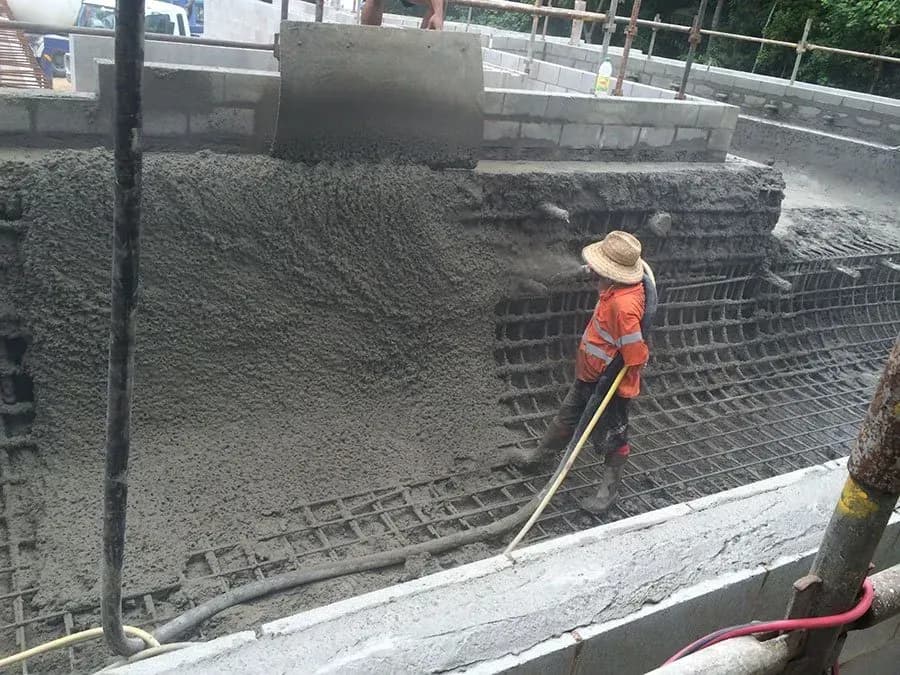
Pouring concrete on a slope works when the concrete goes in from the bottom up. CCAA's datasheet on residential driveways and paths says placement should start at the lowest point on a sloping pavement, to avoid trouble holding the surface tolerances. Its Concrete Basics guide gives the same rule for a sloping site: start from the lowest level and place the concrete as near to its final position as possible.
Three other things decide whether a sloping pour succeeds. The slope itself has to be within the limits for what you are building, which for a driveway means your council's gradient rules. The formwork has to be fixed firmly and set to the finished levels, because it guides the finished surface levels. And the finished surface needs enough texture to grip when it is wet. Each of these is covered below, along with where the truck and pump can set up on a hill and the point where a steep block stops being a concreting job and becomes an engineering one.
How steep is too steep: slopes as ratios, percentages and degrees
Concrete rules quote slopes as ratios (1 in 4) or percentages (25%), while people often think in degrees, so it helps to convert. A 1 in 4 slope rises 1 metre for every 4 metres along, which is 25% and about 14 degrees. A 45 degree slope rises 1 metre for every metre along: 1 in 1, or 100%. That is four times steeper than the steepest driveway limits in this guide. The table converts the slopes that come up in Queensland driveway and earthworks rules (the degree and percentage figures are our arithmetic).
Common slopes converted, with where each figure appears (degrees calculated from the ratio)
| Ratio | Percent | Degrees (approx.) | Where it comes up |
|---|---|---|---|
| 1 in 100 | 1% | 0.6 | CCAA's usual minimum fall so a pavement drains |
| 1 in 20 | 5% | 2.9 | CCAA's general maximum in the footpath area |
| 1 in 10 | 10% | 5.7 | Boral's limit for its concrete trucks, up and across |
| 1 in 6 | 16.6% | 9.5 | FNQROC desirable maximum for a residential driveway |
| 1 in 5 | 20% | 11.3 | FNQROC maximum, for 6 m in every 12 m |
| 1 in 4 | 25% | 14.0 | CCAA's general maximum inside the property boundary |
| 1 in 1 | 100% | 45 | A 45 degree slope: outside any driveway limit here |
Driveway gradient limits in Far North Queensland: check your council first
A concrete driveway in Far North Queensland should generally be no steeper than 1 in 6, with short sections up to 1 in 5. Table D2.1 of the FNQROC Development Manual (Design Manual D2, Site Regrading) gives residential driveways a desirable maximum of 16.6% (1 in 6) and a maximum of 20% (1 in 5) for 6 m in every 12 m, with the change in grade kept to 8% desirable and 10% maximum. FNQROC's members include Cairns Regional, Mareeba Shire, Tablelands Regional, Douglas Shire, Cassowary Coast Regional and Cook Shire councils.
Other guidance is more generous. CCAA gives a general maximum of 1 in 4 (25%) inside the property boundary and 1 in 20 (5%) in the footpath area, and the Queensland Development Code's driveway part (NMP 1.1, published 2008) allows 1 in 4 where the section steeper than 1 in 5 is no longer than 6 metres. CCAA itself says requirements vary, especially in hilly areas, and to check with the local authority. Check with your council before you set out the formwork.
- Transitions: where a driveway is steeper than 12.5%, CCAA says a transition zone at each end of the steep section may be needed to stop cars bottoming out. The Queensland code limits the change in grade to 1 in 8 over at least 1 metre.
- The verge: Cairns Regional Council's crossover fact sheet says the crossfall of a driveway over the road verge must not exceed 2.5% (1:40), and the Queensland code says a driveway meets the road reserve at the level of the existing footpath.
- Approval: Cairns requires Operational Works approval for additional or non-compliant crossovers and driveways, and FNQROC's standard drawing S1015 says crossovers that do not comply with it need approval.
- Steep blocks: FNQROC's road geometry manual (D1) sends access to steep allotments to Design Manual D2, which, unless council agrees otherwise, asks for a concrete driveway at least 3 metres wide with kerb and channel on one side and a one-way crossfall directed into the hill.
Ordering the mix for a sloping pour
Order a sloping pour with the workability your concreter needs written into the order, and never add water on site to make it flow. CCAA's flatwork guide says a 100 mm slump is generally suitable for flatwork. That is general guidance, not a figure for slopes; CCAA notes that lower slump concrete can be ordered, but placing and finishing gets progressively harder without admixtures to improve workability. So the slump for a steep driveway is a decision for your concreter and the concrete supplier, made before pour day.
CCAA's driveways datasheet is firm on water: no water beyond the mixing water needed for the specified slump should be added, because it raises the water to cement ratio, giving lower strength concrete that is less able to resist surface wear. If the concrete is coming through a pump, our guide to pump mix concrete explains how mixes are set up for pumping.
Placing concrete on a slope, step by step: start at the bottom
Concrete is held on a slope by the formwork, the order it goes in and how far it is allowed to travel. CCAA's flatwork guide shows why the order matters: placing from the highest point makes correct levels harder to achieve and can cause segregation, because the concrete tends to settle down the slope. The first five steps below follow CCAA's guidance.
- Fix the formwork firmly and set it to the finished levels. CCAA says formwork should be secured accurately so it holds its line during placing and guides the finished surface levels.
- Set the top and bottom levels as control points. For sloped surfaces, CCAA recommends no more than 10 mm deviation from a line joining the levels at the top and bottom of the slope.
- Start at the lowest point and work uphill, placing each load as near to its final position as possible.
- If placing from a chute, use a baffle and drop at the end. CCAA warns that a free-end chute carries concrete down the slope and separates the aggregate, which ends up at the bottom.
- Do not move concrete along the slope with a vibrator, and do not drop it more than 2 metres, both of which CCAA advises against.
- Finish by texturing the surface for grip (see below).
Where the truck and pump set up on a sloping block
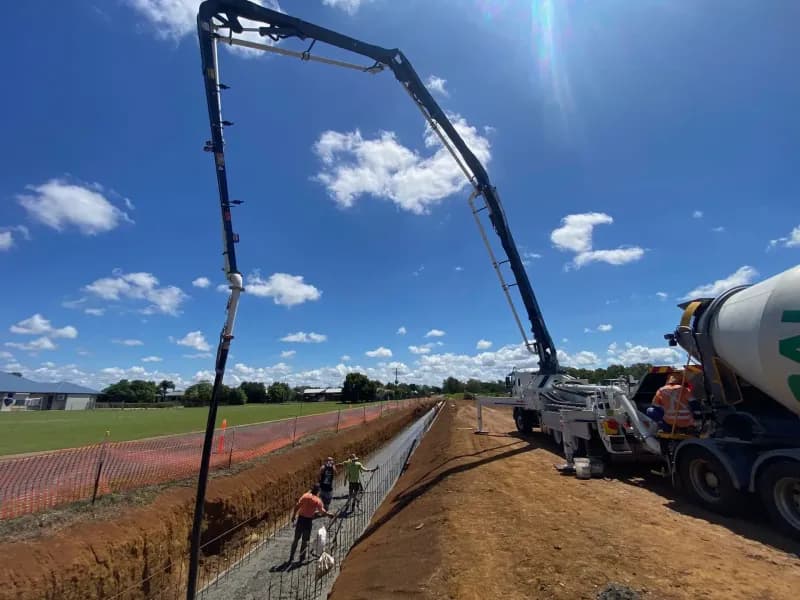
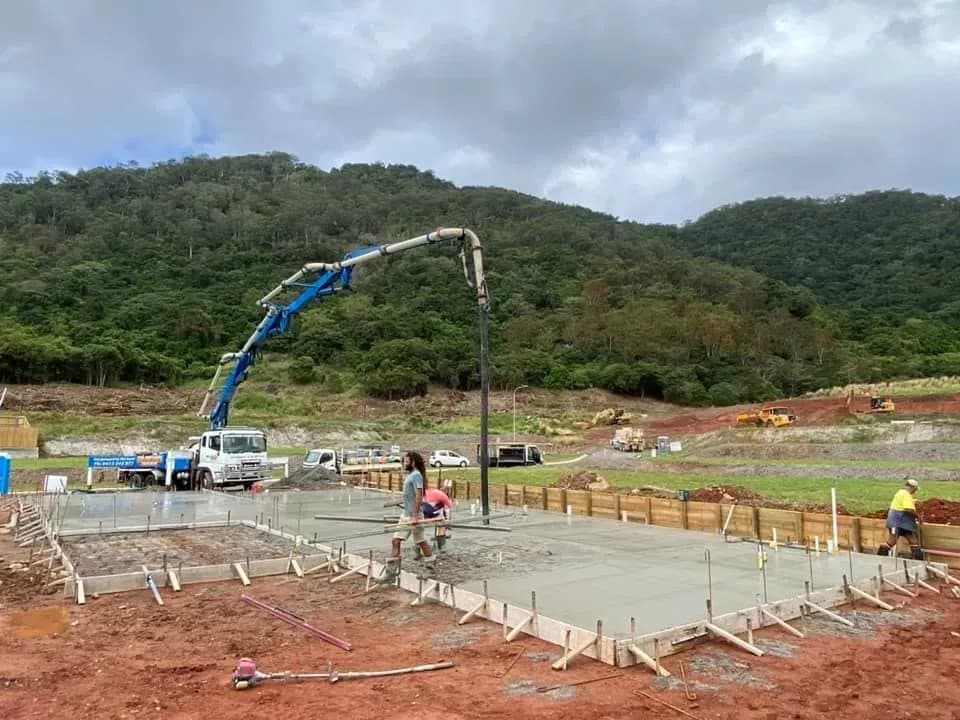
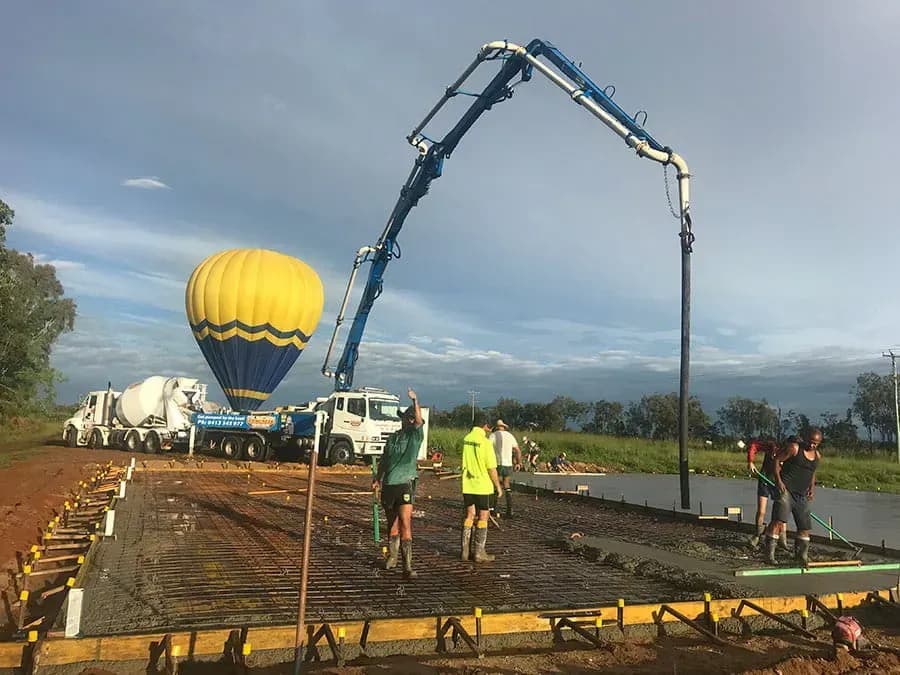
On a steep block, the slope limits where the truck and pump can stand. Boral's delivery requirements say forward gradients must not exceed 1 in 10 for its trucks, and cross slopes the same, so a truck may not be able to drive down to a pour on a block steeper than that. Our guide on whether you need a concrete pump covers when a slope tips the job toward pumping.
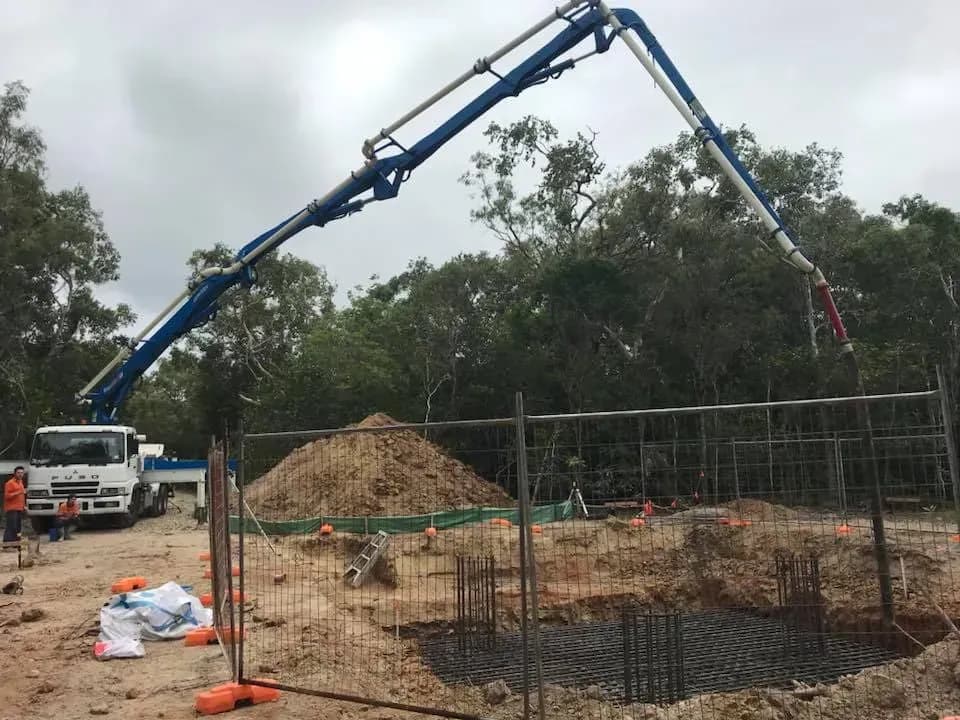
WorkSafe Queensland's Concrete Pumping Code of Practice lists ground slope as a factor that reduces stability and can make a pump move off its supports. It says the pump should be set up level, or at no more incline than the manufacturer allows, and that outrigger timbers on sloping ground should be set into cuts in the ground so they sit level, because outrigger feet can slide off timbers laid on a slope. If the ground is not firm or is near an excavation, the operator refers it to the principal contractor so the pump can be moved.
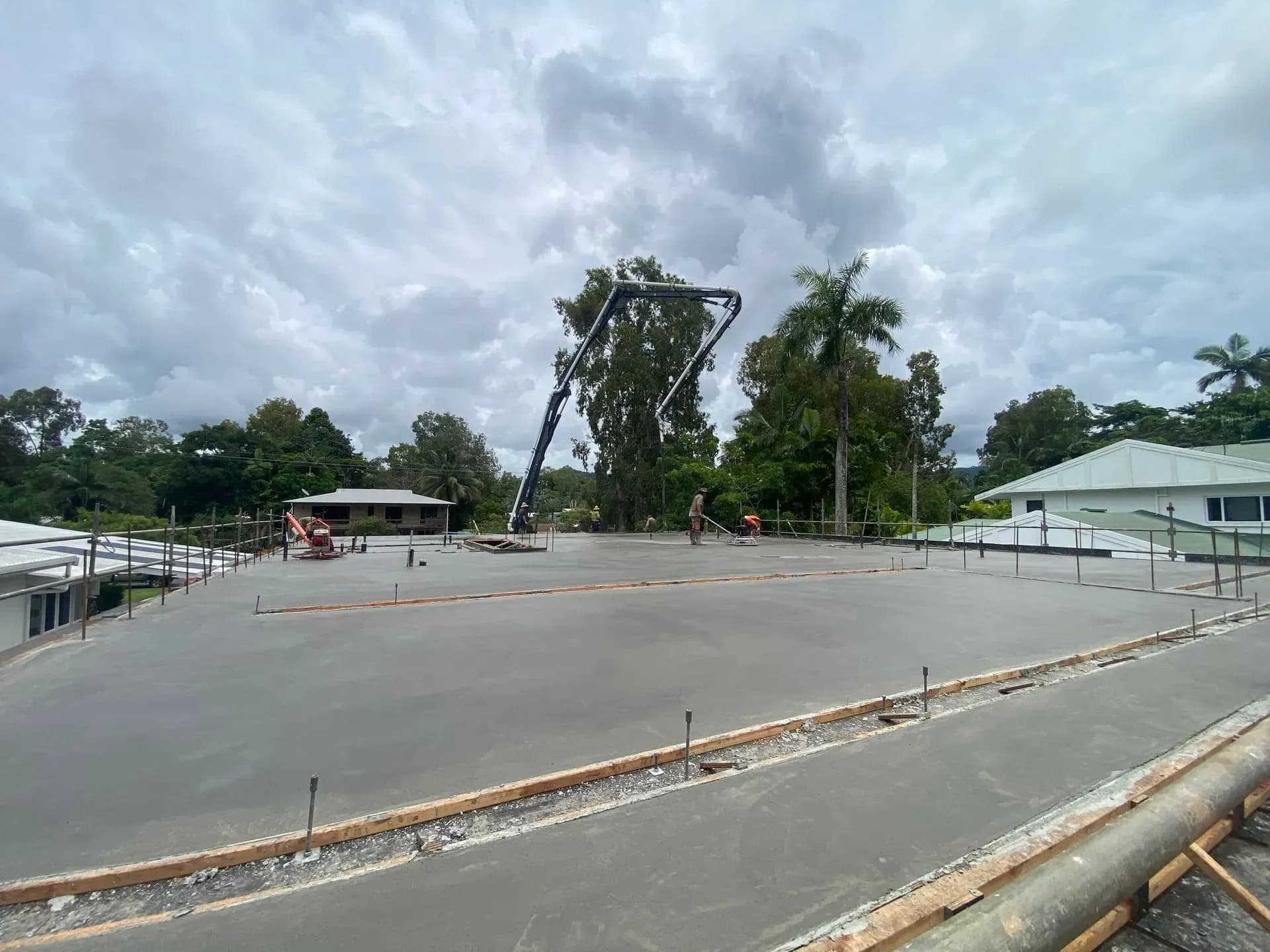
We run 31m, 28m and 20m boom pumps, a line pump and a compact high-pressure line pump, and we assess every worksite for hazards before choosing the pumping method. Give us the height difference and hose distance when you book; our guide to how far a concrete pump can reach explains why both matter, and preparing your site for a concrete pump covers access.
Finishing a sloped surface for grip in the wet season
A sloping concrete surface needs a coarse texture so tyres and shoes grip when it is wet. CCAA's flatwork guide says steep pavements generally need a coarse surface texture for skid and slip resistance, especially if a sealer goes on. Depending on the grade, it says steel trowelled, polished, stamped and smooth aggregate finishes may be unsuitable, and coarse broomed, tined, dragged and stencilled finishes are more suitable. For exposed aggregate on a steep pavement, it suggests angular crushed stone rather than smooth rounded stone.
Council rules point the same way. Cairns Regional Council's crossover checklist says driveway surfaces must be non-slip, FNQROC's crossover drawing S1015 calls for all concrete to be broom finished, and the Queensland code's driveway part gives a broom or exposed aggregate finish as its acceptable surface. Sealers need care too: CCAA says film-forming sealers can reduce slip resistance on steep driveways and recommends penetrating or slip-resistant sealers for steeper grades. To plan a sloping pour around wet weather, read our guide to pouring concrete in the rain before booking.
When a slope becomes an engineering or approval job
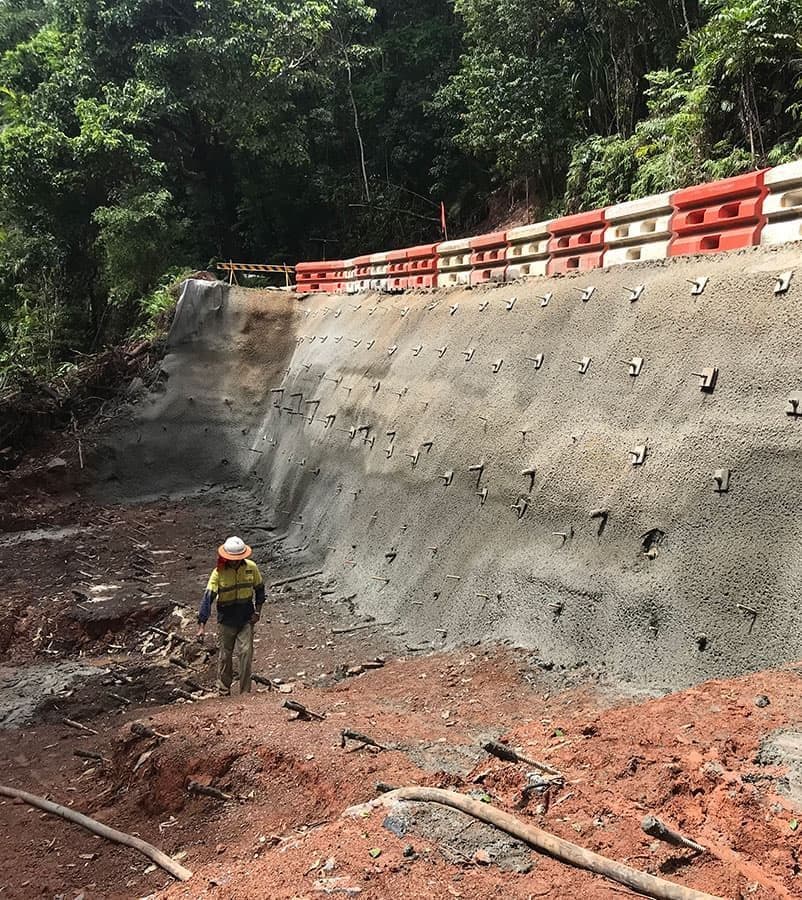
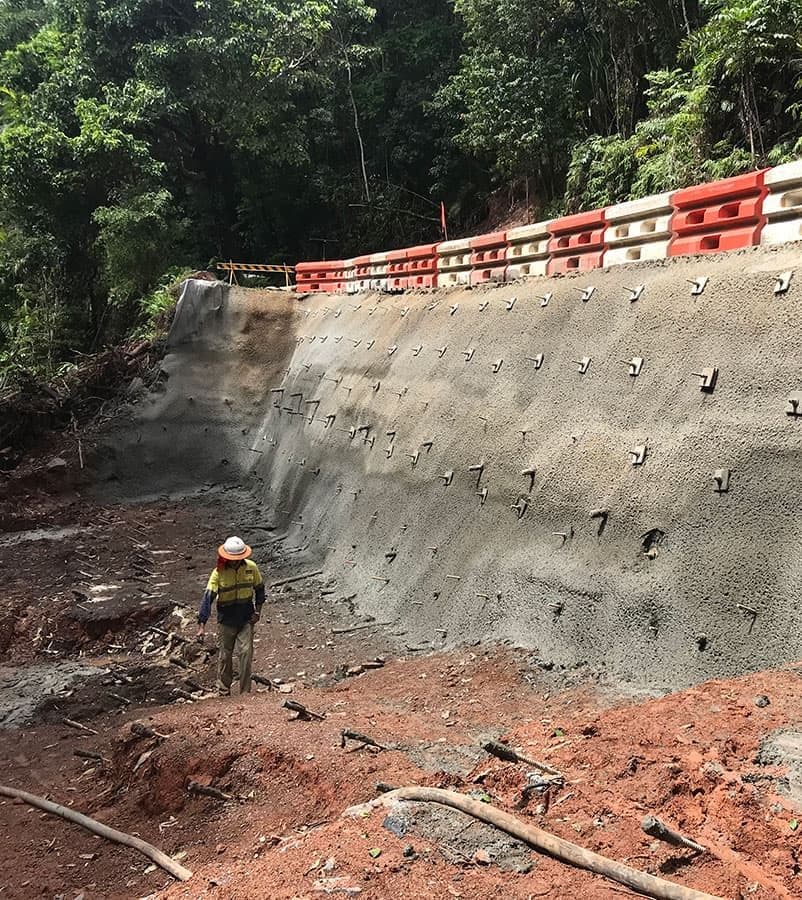
A sloping block becomes an engineering job once the earthworks or retaining needed to make it level go beyond small, owner-scale work. In Queensland, Schedule 1 of the Building Regulation 2021 treats a retaining wall as accepted development only if there is no surcharge loading over its zone of influence, the wall and the cut or fill it holds total no more than 1 metre, and it is at least 1.5 metres from a building or another retaining wall. Cut or fill deeper than 1 metre is also outside that schedule.
FNQROC's Design Manual D2 adds limits for development works: retaining walls over 1.0 m high must be designed, detailed and signed off by a structural engineer, batters steeper than 1 in 2 and higher than 1.5 m need a geotechnical engineer's certification of stability, and where land slopes more than 15%, council requires a geotechnical report on slope stability. A 45 degree slope is far beyond all of these.
Next steps
To work out which machine suits your slope, read our comparison of line pump vs boom pump. For driveways, house slabs and pool surrounds, see our residential concrete pumping work, or the full range of concrete pumping services. We work across Cairns and the Tablelands. When your levels and council answers are sorted, contact us or call 0413 345 977 to book the pump.
Sources
- Residential Concrete Driveways and Paths (datasheet), Cement Concrete & Aggregates Australia. Accessed 30 October 2026.
- Guide to Concrete Flatwork Finishes, Cement Concrete & Aggregates Australia. Accessed 30 October 2026.
- Concrete Basics: A Guide to Concrete Practice, Cement Concrete & Aggregates Australia. Accessed 30 October 2026.
- Design Manual D2: Site Regrading (FNQROC Development Manual, 05/23), Far North Queensland Regional Organisation of Councils. Accessed 30 October 2026.
- Design Manual D1: Road Geometry (FNQROC Development Manual, 05/23), Far North Queensland Regional Organisation of Councils. Accessed 30 October 2026.
- Standard Drawing S1015: Access Crossovers, Far North Queensland Regional Organisation of Councils. Accessed 30 October 2026.
- Membership of Councils, Far North Queensland Regional Organisation of Councils. Accessed 30 October 2026.
- Constructing an access crossover / driveway (fact sheet), Cairns Regional Council. Accessed 30 October 2026.
- Fences and retaining walls, Cairns Regional Council. Accessed 30 October 2026.
- Queensland Development Code NMP 1.1: Driveways, Queensland Government. Accessed 30 October 2026.
- Building Regulation 2021, Schedule 1, Queensland Legislation. Accessed 30 October 2026.
- Concrete pumping Code of Practice 2019, WorkSafe Queensland. Accessed 30 October 2026.
- Concrete Delivery Requirements, Boral. Accessed 30 October 2026.