


In brief
A pump set up on a road or footpath needs approval from whoever controls it: the council for local roads, TMR for state-controlled roads. Cairns Regional Council takes at least 14 days for a permit and TMR recommends applying 4 weeks ahead, plus at least 10 business days for a Traffic Control Permit. Where the area is to be closed, the builder (the principal contractor on a $250,000-plus project) arranges the approval; the pump company supplies the set-up footprint.
On this page
The short answer: yes, if any part of the set-up is on the road or footpath
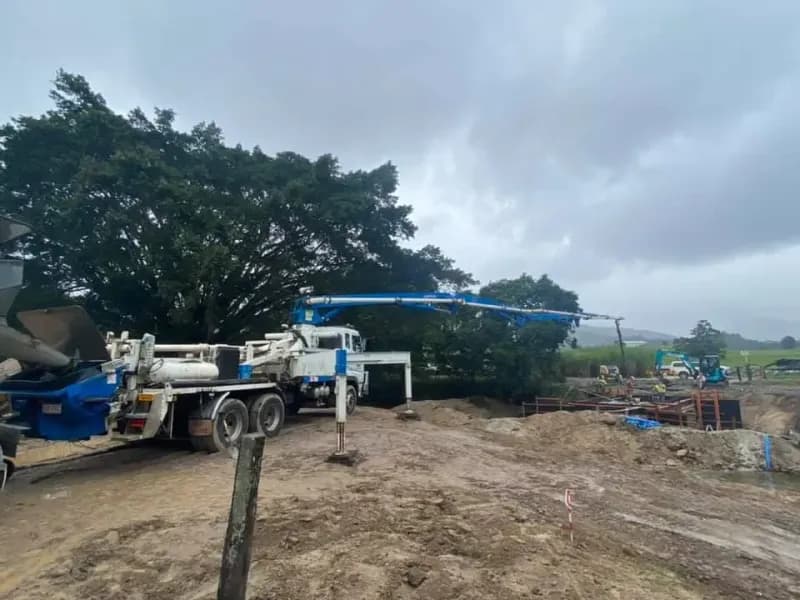
A concrete pump needs a permit whenever the pump or its outriggers will be set up on, or next to, a public road or footpath. Queensland's Concrete Pumping Code of Practice 2019 says the safety plan for the pumping work should ensure permits are obtained from the relevant authority where concrete pumps are set up on, or adjacent to, public roads. The same code notes that pumping operations are often set up on the road or road related areas, and that making room for the pump may include obtaining road or footpath closures from the relevant authority.
The code also quotes the Work Health and Safety Regulation: where the footpath or road next to the site is to be closed, a principal contractor on a construction project (construction work costing $250,000 or more, under sections 292 and 293 of the regulation) must, before construction work starts, get written approval to close it from the authority that controls it, and use whatever closure measures that authority requires, such as physical barriers, signs and traffic controllers. This guide explains which authority that is in Far North Queensland, what each application asks for, how long to allow, and who lodges it. It is general information, not legal advice; the authority's own conditions always apply.
Council roads and state-controlled roads have different approvals
Which approval you need depends on who controls the road in front of the site: the local council or the Queensland Department of Transport and Main Roads. Some roads are state-controlled and others are council roads, and TMR's district maps show state-controlled and local government roads, so check the frontage on those maps or ask your council before you apply. If the pump set-up will also affect a council side street, you may need both approvals.
Council road or state-controlled road: what to apply for
| Question | Council road | State-controlled road |
|---|---|---|
| Who approves | Your council, under its local laws (Cairns: Local Law No. 11; Mareeba: Subordinate Local Law No. 1) | TMR, under section 50 of the Transport Infrastructure Act 1994 |
| Main approval | Usually a permit to alter or improve, or carry out works on, a council controlled road or area, or a temporary road closure (Cairns RC1) | Permission to occupy the road, for example a Road Corridor Permit |
| Traffic | A Traffic Guidance Scheme if the work blocks or impedes pedestrians or vehicles (Cairns) | A separate Traffic Control Permit, lodged by a registered traffic management company or its authorised representative |
| Published lead time | Cairns: minimum 14 days, up to 30 days; road closure form: at least 28 working days | Road Corridor Permit: apply at least 4 weeks ahead; Traffic Control Permit: at least 10 business days |
| Liability cover | Cairns: at least $20 million, noting Council as an interested party | At least $20 million, plus a Deed of Indemnity |
Council roads in Cairns and Mareeba: what the application asks for
On a Cairns council road, a pump set-up that closes part of the footpath or road may fall under Cairns Regional Council's Local Law No. 11 alteration or improvement permit. Under Part 7 of that local law, altering or improving a council controlled area or road is a prescribed activity, and the council lists temporary footpath and road closures, with safety fencing or barriers, to establish a building construction zone as an example. If the set-up closes the road itself, council may direct you to its temporary road closure form (RC1) instead, so confirm which applies. For the Local Law No. 11 permit, Cairns asks for:
- A site plan: an aerial view sketch with measurements, showing the permit area, the equipment, machinery and vehicles to be used, and permanent infrastructure such as trees, fire hydrants and power poles.
- A certificate of currency for public liability insurance of at least $20 million, in the applicant's name, covering the permit period and noting Cairns Regional Council as an interested party.
- A site-specific Traffic Guidance Scheme if the work will block or impede pedestrian or vehicle traffic.
- A Parking Bay Permit application if you need exclusive use of regulated parking bays such as a loading zone, which carries extra fees.
In the Mareeba Shire, the council's guideline covers applications for carrying out works on a road or interfering with a road or its operation, a prescribed activity under Schedule 30 of Subordinate Local Law No. 1 (Administration) 2018. It assesses works on roads as extreme to moderate risk and expects evidence of public liability insurance. Ask Mareeba Shire Council which of its road forms suits a pump set-up.
State-controlled roads: TMR permission plus a Traffic Control Permit
If the site fronts a state-controlled road, you need TMR's permission to occupy the road and, if traffic or pedestrians will be affected, a Traffic Control Permit as well. TMR says departmental approval is required under section 50 of the Transport Infrastructure Act 1994 for activities within the boundaries of a state-controlled road, applied for as a Road Corridor Permit. It also says any potential interruption to traffic flow, pedestrian movements or public transport on a state-controlled road requires a Traffic Control Permit in addition, obtained before each activity.
The order matters. TMR says permission to occupy the state-controlled road must be sought before anyone applies for a Traffic Control Permit. For the Road Corridor Permit, TMR asks for the exact location, a description of the activity, how long it will be in the road corridor and the number of people involved, plus a liability insurance certificate of at least $20 million and a Deed of Indemnity. The Traffic Control Permit is then lodged by a traffic management company registered under TMR's Traffic Management Registration Scheme, or its authorised representative, with a Traffic Management Plan approved by an appropriately qualified person.
Traffic control: set by the Traffic Guidance Scheme, not by how quiet the street is
A quiet street does not by itself remove the need for traffic control; what the road authority requires and the approved Traffic Guidance Scheme say decides it. The Queensland code lists the traffic control measures to consider for a pump on or beside a road: road closures, footpath closures, detours, signs and traffic controllers. It says lane closures, signs, speed restriction signage and barriers for work on or next to public roads must comply with AS 1742, and that the necessary barriers and signage must be in place no matter how brief the occupation. TMR has harmonised the Queensland Manual of Uniform Traffic Control Devices Part 3 with AS 1742.3.
In Cairns, a Traffic Guidance Scheme must be prepared by a Queensland person accredited to make and approve such plans, to the Queensland MUTCD, and temporary signs go where that scheme shows. Cairns' road closure form goes further: applications affecting road users need a scheme or plan from a licensed traffic management company, and qualified traffic controllers or the police for any traffic control. TMR accredits the individuals authorised to control traffic at roadworks sites.
Lead times: lodge before you book the pump
Allow weeks, not days. Cairns Regional Council says its Local Law No. 11 permit takes a minimum of 14 days and up to 30 days to process, and it will not accept an application with a start date less than 14 days from submission. Its temporary road closure form, which has a works and construction option, asks you to allow at least 28 working days. TMR recommends lodging a Road Corridor Permit at least 4 weeks before it is needed, and a Traffic Control Permit needs at least 10 business days on top. Other councils publish their own times, so ask yours.
- Get the pump's set-up footprint, in metres with outriggers extended, from the pumping business.
- Check whether the frontage is a council road or a state-controlled road.
- Engage a traffic management company if the set-up will block or impede traffic or pedestrians.
- Lodge the council or TMR application with the site plan, insurance and traffic scheme.
- Book the pour date once the approval timeline is clear.
The code also tells sites to allow for restricted work times under local authority rules when they set the pour schedule.
Who applies: usually the builder, with information from the pump company
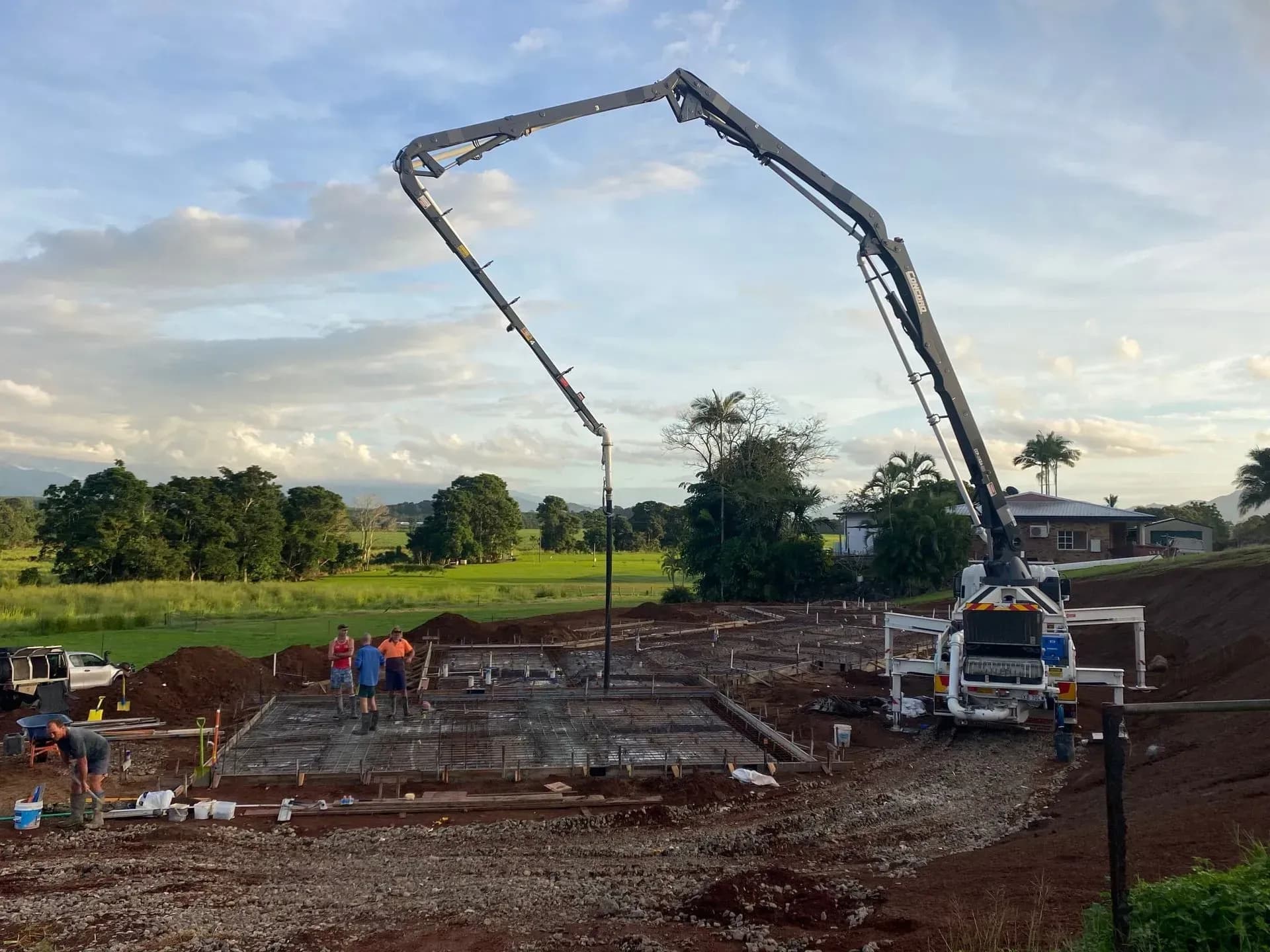
Usually the builder applies for the road or footpath approval, and the pumping business supplies the information the application needs. Under the WHS Regulation section quoted in the Queensland code, on a construction project of $250,000 or more, where the adjoining area is to be closed, the principal contractor must ensure written approval to close it is obtained from the authority controlling it before construction work starts. The code then says the pumping business should give the person in control of the site the area it needs with the outriggers fully extended, as a length by width in metres, which is what goes on the site plan.
If you are an owner-builder with no builder engaged, ask the council whose name the application should be in. On a state-controlled road, the Traffic Control Permit is the exception: TMR says the applicant must be the traffic management company doing the traffic control, or its authorised representative, and the permit is issued to that company. Cairns also says the permit holder pays to reinstate the area afterwards, and suggests photographing its condition before the permit starts.
Questions to ask your council before lodging
Outside Cairns and Mareeba, the Tablelands, Douglas, Cassowary Coast and Cook councils each set their own forms, fees and processing times, and this guide does not state them. Before you lodge, ask your council:
- Is the road in front of the site a council road or a state-controlled road?
- Which permit covers a concrete pump and concrete trucks on the road or footpath for one day?
- How many days before the pour must the application be lodged, and what is the fee?
- Do you need a Traffic Guidance Scheme, and who may prepare it?
- What insurance amount, and which interested party wording, do you need on the certificate?
- Are there restricted work hours, or rules for parking bays and loading zones?
- Where must pump and truck washout go when the set-up is in the road? The code expects a way to stop residue reaching stormwater drains, particularly for a pump set up in a roadway or public place.
For washout options on a street set-up, see concrete washout, and for the safety paperwork that sits alongside the permit, see concrete pumping SWMS.
Planning a street set-up with us
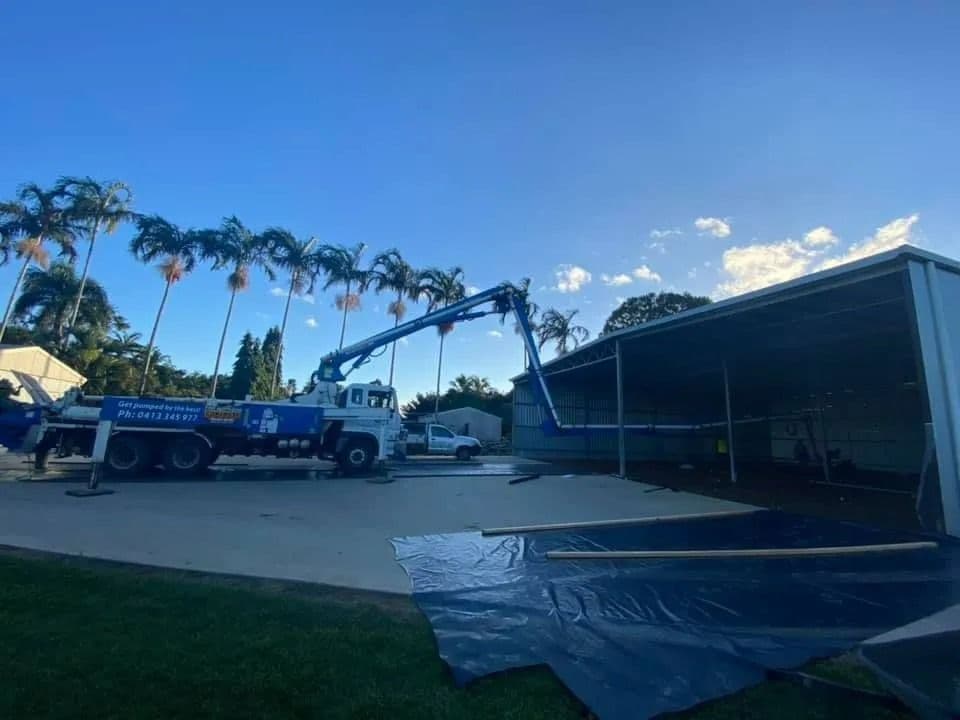
Far Northern Concrete Pumping is based in Mareeba and pumps for residential, commercial and civil pours across Cairns, the Tablelands, Cape York and the rest of Far North Queensland; see all the areas we service. Our operators have access to a 31m boom pump, 28m boom pump, 20m boom pump and line pump, and the set-up footprint differs between them, so tell us the site address when you book and ask for the footprint you need for the permit. On narrow frontages, line pump vs boom pump explains when a line run down the side of the block is the alternative to a boom set up on the street. Our Westcourt page covers pours on busier Cairns frontages.
Next steps
With the permit route worked out, run through the rest of the checklist in preparing your site for a concrete pump, from ground conditions to powerlines. Then contact us or call 0413 345 977 with the address, pour type, volume and photos of the frontage so we can confirm the right concrete pumping equipment and its set-up area.
Sources
- Concrete Pumping Code of Practice 2019, WorkSafe Queensland. Accessed 30 October 2026.
- Alteration or improvement to Local Government controlled areas or roads (Local Law 11), Cairns Regional Council. Accessed 30 October 2026.
- Application for Temporary Road Closure (including Events on Council roads), Cairns Regional Council. Accessed 30 October 2026.
- Guidelines for Carrying Out Works on a Road or Interfering with a Road or its Operation, Mareeba Shire Council. Accessed 30 October 2026.
- Approval for works on public areas and roads: Mareeba Shire Council, Australian Government, business.gov.au (ABLIS). Accessed 30 October 2026.
- Road Corridor Permit, Queensland Department of Transport and Main Roads. Accessed 30 October 2026.
- Traffic control permit, Queensland Department of Transport and Main Roads. Accessed 30 October 2026.
- Temporary Traffic Management, Queensland Department of Transport and Main Roads. Accessed 30 October 2026.
- Queensland State-controlled roads and region maps, Queensland Department of Transport and Main Roads. Accessed 30 October 2026.
- Work Health and Safety Regulation 2011, sections 292, 293 and 315M, Queensland Government, Queensland Legislation. Accessed 30 October 2026.